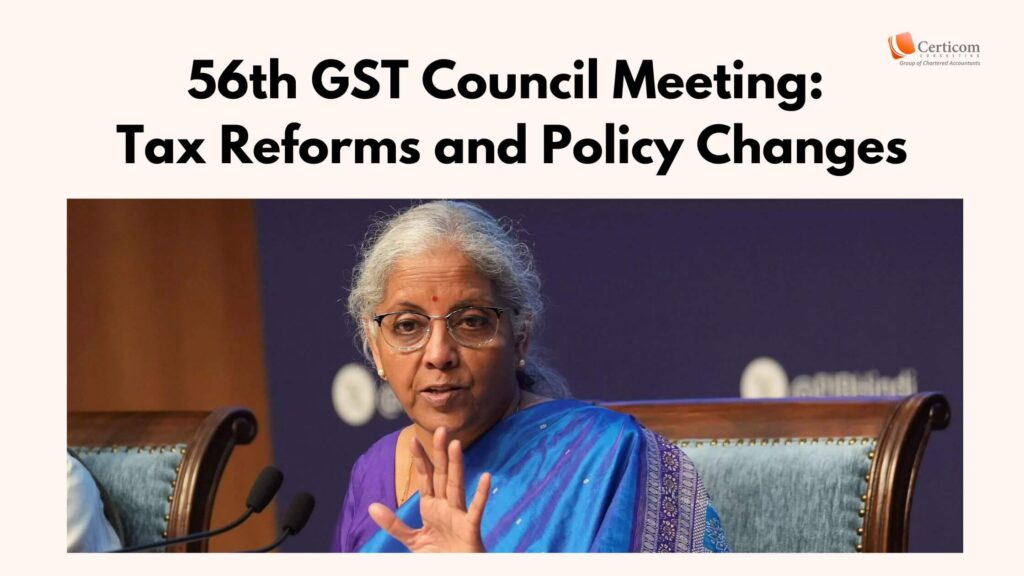

The 56th GST Council Meeting, held on 3rd September 2025, has set the stage for the next phase of India’s indirect tax system. With the objective of simplifying the GST regime, rationalizing tax rates, and aligning policies with global trade practices, the Council has rolled out several key measures that will impact businesses across industries.
Most of the recommendations will take effect from 22nd September 2025, giving businesses a short window to upgrade systems and prepare for compliance. The reforms are centered around four main pillars:
Simplified GST rate structure
Correction of inverted duty structures
Seamless refund mechanisms
Digital integration for compliance and transparency
One of the most significant decisions was the adoption of a simplified three-slab structure, replacing the earlier five-tier system:
Merit Rate – 5%: Essential goods & services (e.g., UHT milk, paneer, educational stationery)
Standard Rate – 18%: General goods & services
De-Merit Rate – 40%: Sin goods (e.g., tobacco, pan masala, luxury vehicles)
Inverted duty structure correction in textiles, chemicals, and fertilizers.
Lower tax burden on essential goods like milk, paneer, cereals, and stationery.
Higher taxation on luxury and sin goods to align with public health and revenue goals.
Businesses must update their ERP and invoicing systems with revised HSN codes as per CBIC’s Annexure-I. Some major changes:
| HSN Code | Goods Description | Old Rate | New Rate |
|---|---|---|---|
| 0401 | UHT Milk | 5% | NIL |
| 0406 | Paneer (pre-packaged) | 5% | NIL |
| 1701/1702 | Sugar & related products | 12% | 5% |
| 1901 | Infant food/cereals | 12% | 5% |
| 5406/5407 | Man-made fibres & yarn | 18% | 12% |
| 8703 | Electric vehicles | 18% | 5% |
| 4901 | Educational stationery, maps | 12% | NIL |
| 3004 | Life-saving drugs & devices | 5% | NIL |
| 2711 | Natural gas | 12% | 5% |
FMCG: Lower rates to boost consumer demand but requires MRP recalibration.
Textiles: Reduction to 12% improves working capital efficiency.
Automobile: EVs at 5% GST encourage clean mobility adoption.
Healthcare: Life-saving medicines are now tax-free.
The services sector will also undergo major changes with revised SAC codes. Some notable revisions include:
| SAC Code | Service Type | Old Rate | New Rate | ITC Eligibility |
| 9963 | Hotel accommodation ≤ ₹7,500/day | 12% | 5% | Without ITC |
| 9997 | Beauty & wellness (gyms, salons, yoga) | 18% | 5% | Without ITC |
| 9971 | Third-party insurance (goods carriage) | 12% | 5% | With ITC |
| 9964 | Air passenger transport (non-economy) | 12% | 18% | With ITC |
| 9965 | Goods Transport Agency (GTA) | 5% | 12-18% | With ITC |
| 9967 | Pipeline transport | 5% | 18% | With ITC |
| 9988 | Job work (printing, pharma, leather) | 12% | 5% | With ITC |
| 9991 | Cinema tickets ≤ ₹100 | 12% | 5% | With ITC |
| 9992 | Waste treatment & biomedical disposal | 12% | 5% | With ITC |
| 9993 | Actionable claims (betting, casinos) | 28% | 40% | With ITC |
Hospitality & Wellness: Rates reduced but without ITC, affecting cost structures.
Logistics: GTA now has multiple categories requiring precise contract drafting.
Gaming: Casinos & betting face higher tax at 40%.
The revised GST rates also affect customs and international trade policies.
Key Customs Measures:
Fast-Track Refunds: Priority processing for consignments under ₹1,000.
Provisional Refunds: 90% of inverted duty refunds released upfront.
IGST & Customs Duty Alignment: Harmonization across diamonds, electronics, and textiles.
FTP Synchronization: DGFT notifications will align SEZ, EOU, and Advance Authorisation schemes with new GST rates.
Despite the benefits, businesses may face short-term hurdles:
Pending legislative amendments in CGST & SGST Acts.
ERP and billing system upgrades before 22nd September.
Transitional handling of invoices, e-way bills, and reconciliations.
Revenue loss concerns for states due to lower rates.
To ensure compliance and smooth transition, businesses should:
Update ERP & billing systems with new HSN/SAC codes.
Train finance and compliance teams.
Recalculate MRPs and revise contracts.
Reconcile pending refund claims before transitional rules.
Communicate changes across distribution and logistics networks.
Q1: When do new rates apply? From 22nd September 2025.
Q2: What about advances before 22nd September? Section 14 CGST Act applies.
Q3: Can ITC be claimed on old inputs? Yes, if used for taxable supplies.
Q4: Are insurance services exempt? Yes, life & health insurance are exempt post 22nd September.
Q5: New GST rate on EVs? Reduced to 5%.
The 56th GST Council Meeting marks the beginning of GST 2.0—a simpler, more efficient, and globally aligned tax framework. While the reforms bring relief to consumers and exporters, businesses must act swiftly to reconfigure systems, contracts, and pricing. The transition is not just about rate changes but a paradigm shift in India’s indirect tax ecosystem, aimed at driving long-term competitiveness and sustainable growth.
How can we help? *