


An Overview of Assessment Procedures Under GST

Assessment

An Overview of Assessment Procedures Under GST

Assessment

Assessment under the Goods and Services Tax (GST) refers to the determination of the tax liability of a person who is registered — or required to be registered — under the GST law. Assessments ensure that taxes are reported correctly, paid on time, and aligned with the provisions of the Central Goods and Services Tax (CGST) Act.

To address different compliance situations, the GST framework provides multiple types of assessments. These range from self-declared liabilities by taxpayers to assessments initiated by tax authorities in cases of non-compliance.

1. Self-Assessment (Section 59)

Self-assessment is the default mechanism under GST and is followed by every registered taxpayer. Under this system, the taxpayer independently computes:

  • the value of taxable supplies,

  • the applicable GST rate,

  • eligible Input Tax Credit (ITC), and

  • the final tax payable,

and reports these details in periodic returns such as GSTR-1, GSTR-3B, and the annual return.

At this stage, there is no intervention from the tax department — making GST largely trust-based and compliance-driven.

Example

ABC Traders sells goods worth ₹10,00,000 at 18% GST.

  • Output GST = ₹1,80,000

  • ITC available = ₹1,20,000

Tax payable = ₹1,80,000 – ₹1,20,000 = ₹60,000

ABC files returns and pays ₹60,000. This is self-assessment because the taxpayer independently determines and discharges the liability.

2. Provisional Assessment (Section 60)

Provisional assessment applies when a taxpayer is uncertain about:

  • the value of supply, or

  • the correct tax rate.

In such cases, the taxpayer may request permission to pay tax on a provisional basis. The tax officer may allow provisional assessment after obtaining a bond and appropriate security. Once clarity is obtained, a final assessment is completed and any shortfall or excess payment is adjusted, along with interest where applicable.

Example

XYZ Ltd launches a new product and is unsure whether GST should apply at 12% or 18%. The company applies for provisional assessment and is allowed to pay at 12% temporarily.

Later, it is decided that the correct rate is 18%. XYZ Ltd must pay the additional 6% with applicable interest. This is provisional assessment.

3. Scrutiny Assessment (Section 61)

Scrutiny assessment involves the examination of GST returns to verify accuracy and consistency. The tax officer reviews filed returns and checks for discrepancies, such as:

  • mismatches in ITC,

  • errors in tax computation, or

  • inconsistencies across returns.

If differences are detected, the taxpayer is issued a notice seeking clarification. Where the explanation is satisfactory, the matter is closed. Otherwise, it may progress to audit or demand proceedings.

Example

A GST officer notices that PQR Enterprises has claimed ITC in GSTR-3B that exceeds the credit reflected in GSTR-2B. A notice is issued. After reconciling and providing valid invoices, PQR justifies the claim. No further action is taken.

This process is scrutiny assessment.

4. Best Judgment Assessment (Sections 62 and 63)

Best judgment assessment is applied when taxpayers fail to comply with GST obligations.

Section 62 – Registered Persons Who Do Not File Returns

If a registered taxpayer does not file returns despite notices, the officer may assess liability based on available records and past transactions.

Example

LMN Traders fails to file GST returns for six months. The tax officer estimates liability using historical data and issues an assessment order. This is best judgment assessment under Section 62.

Section 63 – Unregistered Persons Liable to Pay Tax

This provision applies to persons who should have registered under GST but did not.

Example

Mr. Akash operates a business exceeding the threshold limit but does not obtain GST registration. Upon detection, the officer assesses liability based on business records and market data. This falls under Section 63.

5. Summary Assessment (Section 64)

Summary assessment is an extraordinary measure used to safeguard government revenue where delays may jeopardize recovery. It can be initiated only when:

  • there is clear evidence of tax liability, and

  • postponing assessment could adversely affect revenue.

Prior approval from a senior officer is required. The affected taxpayer may request withdrawal of the order if it is unjustified.

Summary assessments are typically used in cases involving:

  • fraud or evasion,

  • perishable goods,

  • unaccounted stock, or

  • situations where the taxpayer may abscond.

Assessment

5. Summary Assessment (Section 64)

SituationValue (₹)GST RateTax Assessed (₹)Reason
Unreported sales without invoice50,00,00018%9,00,000Risk of closure and revenue loss
Unaccounted stock found during inspection20,00,00012%2,40,000Goods may be disposed
Goods in transit without valid documents10,00,0005%50,000Immediate recovery required
Wrong person assessed (withdrawn later)30,00,00018%5,40,000Order cancelled within 30 days
Fake invoices issued to claim ITC1,00,00,00018%18,00,000High risk of disappearance

Final Thoughts

The GST assessment framework is designed to promote voluntary compliance while empowering authorities to act in cases of risk, uncertainty, or non-compliance. Understanding these assessment types helps taxpayers:

  • file accurate returns,

  • avoid penalties and litigation, and

  • respond effectively to departmental notices.

Maintaining proper documentation, reconciling data regularly, and seeking expert guidance where necessary can significantly reduce exposure to assessment-related issues.

Related Post

image

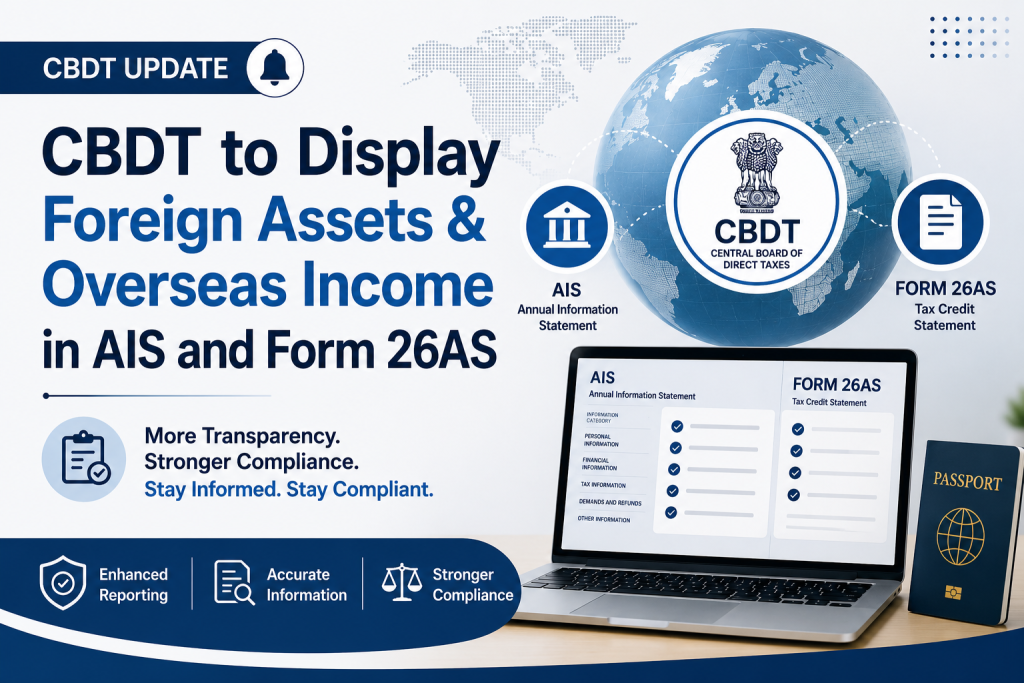
CBDT to Display Foreign Assets & Overseas Income in AIS and Form 26AS

CBDT to Display Foreign Assets & Overseas Income in AIS and Form 26AS On 8 July 2026, the Central Board of Direct Taxes (CBDT) issued a landmark directive (Order F.No.…
image

ITR-1 vs ITR-2 vs ITR-4 for AY 2026-27: How to Choose the Right Income Tax Return Form

ITR-1 vs ITR-2 vs ITR-4 for AY 2026-27: How to Choose the Right Income Tax Return Form Filing your Income Tax Return (ITR) begins with one critical decision—selecting the correct…
image

Who Qualifies as a Relative Under the Income-tax Act, 1961?

Who Qualifies as a Relative Under the Income-tax Act, 1961? The term "relative" may appear straightforward, but under the Income-tax Act, 1961, it does not have a single universal definition.…
Book A One To One Consultation Now
For FREE

How can we help? *

GST ITC Reconciliation: Challenges and Solutions for Businesses

ITC

GST ITC Reconciliation: Challenges and Solutions for Businesses

ITC

When the Goods and Services Tax (GST) was launched in 2017, it was hailed as a landmark reform aimed at unifying India’s indirect taxation system under the principle of “one nation, one tax.” Businesses across sectors welcomed it with optimism, expecting fewer tax complications, removal of cascading taxes, and an overall boost to ease of doing business.

At the core of this reform lies Input Tax Credit (ITC)—a mechanism designed to allow businesses to set off the GST paid on purchases against the GST payable on sales. In principle, ITC should reduce costs, increase transparency, and prevent double taxation. But over the years, its practical implementation has proved far more challenging, especially for micro, small, and medium enterprises (MSMEs). For many, ITC has turned from a business enabler into a compliance burden, often tying up working capital and triggering litigation.

What is Input Tax Credit (ITC)?

Simply put, ITC allows a registered business to offset the GST it has already paid on inputs against the GST it collects on outputs.

Example:

A manufacturer purchases raw materials worth ₹1,00,000 and pays 18% GST (₹18,000). The finished goods are later sold for ₹1,50,000 with 18% GST (₹27,000). Instead of paying the full ₹27,000 as output tax, the manufacturer can claim credit for ₹18,000 and pay only the balance ₹9,000.

This ensures that GST is applied only on value addition at each stage, not on the entire transaction amount. However, in practice, the system is burdened by stringent compliance requirements.

Legal Framework of ITC

The rules governing ITC are contained in Chapter V of the CGST Act, 2017 (Sections 16–21) and corresponding GST Rules. Some key provisions include:

  • Section 16(1): Right of a registered person to claim ITC on goods or services used for business purposes.

  • Section 16(2): Conditions include valid tax invoices, actual receipt of goods/services, supplier’s tax payment to the government, and timely filing of returns.

  • Section 17: Restrictions and apportionment of ITC (e.g., blocked credit on personal consumption, motor vehicles for personal use, etc.).

  • Section 18: Special cases like new registrations or switching from composition to regular schemes.

  • Rule 86A: Empowers officers to block ITC if fraudulent activity is suspected—though this often impacts genuine taxpayers as well.

ITC as a Boon for Businesses

Despite its complexities, ITC has undeniable advantages:

  1. No more tax on tax: ITC eliminated cascading taxes that plagued the pre-GST regime.

  2. Lower business costs: Passing on credit lowers the overall tax burden, making goods and services more competitive.

  3. Greater formalization: Since ITC is available only when suppliers are GST-compliant, it pushes businesses into the organized sector.

  4. Improved cash flow: When compliance runs smoothly, ITC prevents businesses from bearing tax liability on the entire turnover.

ITC as a Burden for Businesses

For many, particularly MSMEs, ITC has created more pain points than relief:

  1. Vendor dependency: Even if a buyer pays their supplier, ITC may be denied if the supplier defaults in filing or paying GST.

  2. Frequent changes: Constant amendments and notifications make compliance difficult, especially for smaller businesses.

  3. Blocking of ITC: Under Rule 86A, tax officers can block ITC on suspicion, which severely affects working capital.

  4. Litigation overload: Disputes around construction, CSR spends, promotional schemes, and refund eligibility keep businesses entangled in litigation.

  5. MSME disadvantage: While large corporations can absorb compliance costs, MSMEs face disproportionate strain on resources and cash flow.

The MSME Struggle

MSMEs, which contribute nearly 30% of India’s GDP, are disproportionately affected:

  • Supplier defaults directly impact their ITC claims.

  • Refund delays create cash flow bottlenecks.

  • Compliance costs eat into already thin margins.

  • Even small mistakes invite penalties, interest, or litigation.

Instead of easing business operations, ITC often feels like another obstacle for MSMEs.

Boon or Burden?

The reality of ITC depends on the size and resources of a business:

  • For large corporations: ITC is largely beneficial, helping reduce costs and improve global competitiveness.

  • For MSMEs: ITC often acts as a burden due to dependency on suppliers, delayed refunds, and complex compliance requirements.

Thus, ITC’s success lies not in its concept but in its administration.

ITC

Suggested Reforms

To make ITC more effective and less contentious, the following reforms can be considered:

  • Protect genuine buyers: ITC should not be denied to compliant taxpayers just because a vendor defaults.

  • Stability in law: Minimize frequent changes and provide clear guidelines.

  • Faster refunds: Particularly for MSMEs and exporters, refund timelines need strict enforcement.

  • Tech-enabled compliance: AI-driven reconciliation tools can simplify return matching.

  • Awareness initiatives: Government outreach and MSME-focused training can improve compliance capacity.

Conclusion

Input Tax Credit was envisioned as the backbone of GST—eliminating cascading taxes and making business more efficient. While it has certainly streamlined taxation for large corporations, its implementation challenges have made it a heavy burden for MSMEs.

The government’s challenge lies in striking the right balance between protecting revenue and easing compliance. With reforms aimed at simplification, faster refunds, and safeguarding genuine taxpayers, ITC can truly evolve into the boon it was meant to be. Until then, the debate on whether ITC is a blessing or a burden will remain alive in boardrooms, courtrooms, and policymaking circles.

Related Post

image

CBDT to Display Foreign Assets & Overseas Income in AIS and Form 26AS

CBDT to Display Foreign Assets & Overseas Income in AIS and Form 26AS On 8 July 2026, the Central Board of Direct Taxes (CBDT) issued a landmark directive (Order F.No.…
image

ITR-1 vs ITR-2 vs ITR-4 for AY 2026-27: How to Choose the Right Income Tax Return Form

ITR-1 vs ITR-2 vs ITR-4 for AY 2026-27: How to Choose the Right Income Tax Return Form Filing your Income Tax Return (ITR) begins with one critical decision—selecting the correct…
image

Who Qualifies as a Relative Under the Income-tax Act, 1961?

Who Qualifies as a Relative Under the Income-tax Act, 1961? The term "relative" may appear straightforward, but under the Income-tax Act, 1961, it does not have a single universal definition.…

Book A One To One Consultation Now
For FREE

How can we help? *