
New ITR Forms Under Income Tax Act, 2025 to Be Notified by January

Income Tax

New ITR Forms Under Income Tax Act, 2025 to Be Notified by January

Income Tax

The transition to India’s new Income Tax Act, 2025 is steadily moving forward, and taxpayers now have a clearer timeline. According to CBDT Chairman Ravi Agrawal, the revised Income Tax Return (ITR) forms and related rules will be officially notified by January 2026, giving individuals and businesses enough time to prepare before the new law becomes effective on April 1, 2026.

Speaking at the India International Trade Fair, the CBDT chief stressed a key objective behind the overhaul: simplifying compliance. The department aims to design ITR forms that are significantly easier for taxpayers to understand and file.

A Major Overhaul of the 1961 Income Tax Act

The Income Tax Act, 2025—which received parliamentary approval on August 12—marks the most significant reform of India’s direct tax legislation in over six decades. While the new Act does not change tax rates, it substantially reworks how provisions are structured and presented.

Here’s what the new framework brings:

1. Fewer Sections, Greater Clarity

  • Sections reduced from 819 (1961 Act) to 536

  • Chapters reduced from 47 to 23

2. Cleaner Language

  • Total word count reduced from 5.12 lakh to 2.6 lakh

  • Archaic and redundant provisions removed

  • Complex text substituted with 39 structured tables and 40 computation formulas for better transparency

This restructuring aims to make the law more accessible to taxpayers, professionals, and administrators alike.

Income Tax

ITR and TDS Forms Being Completely Reworked

All forms under the new Act—including:

  • ITR forms, and

  • TDS/TCS quarterly return forms

—are being redesigned. The CBDT’s Directorate of Systems is collaborating with the tax policy division to build forms that match the simplified spirit of the new law.

Once vetted by the Ministry of Law, the final rules and forms will be notified and placed before Parliament.

Why Notification by January Matters

Notifying the forms early gives taxpayers and organisations—especially corporates, payroll teams, and ERP-driven systems—sufficient time to:

  • Update internal tax workflows

  • Configure accounting and payroll software

  • Train staff on new requirements

  • Ensure smooth filing from April 1, 2026

This lead time is crucial during such a large regulatory transition.

What Taxpayers Should Do Now

While no action is required immediately, you can stay prepared by:

  • Tracking CBDT updates through official channels

  • Understanding the new law’s structure

  • Reviewing how your income or business transactions will be classified under the simplified provisions

The coming months will offer greater clarity as the draft forms and rules are released.

Related Post

image

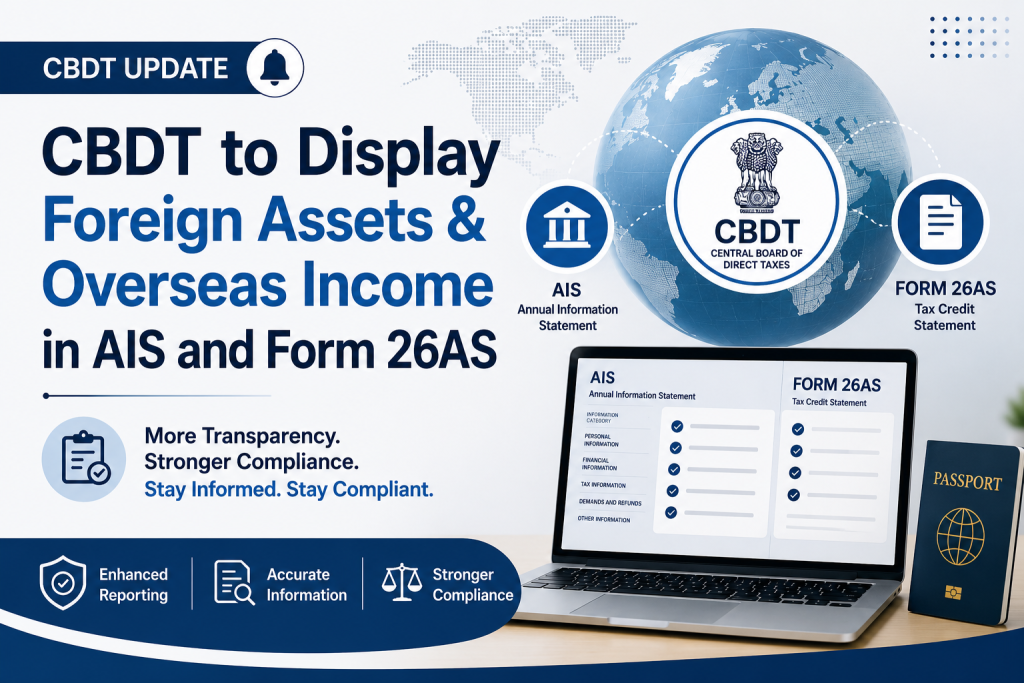
CBDT to Display Foreign Assets & Overseas Income in AIS and Form 26AS

CBDT to Display Foreign Assets & Overseas Income in AIS and Form 26AS On 8 July 2026, the Central Board of Direct Taxes (CBDT) issued a landmark directive (Order F.No.…
image

ITR-1 vs ITR-2 vs ITR-4 for AY 2026-27: How to Choose the Right Income Tax Return Form

ITR-1 vs ITR-2 vs ITR-4 for AY 2026-27: How to Choose the Right Income Tax Return Form Filing your Income Tax Return (ITR) begins with one critical decision—selecting the correct…
image

Who Qualifies as a Relative Under the Income-tax Act, 1961?

Who Qualifies as a Relative Under the Income-tax Act, 1961? The term "relative" may appear straightforward, but under the Income-tax Act, 1961, it does not have a single universal definition.…
Book A One To One Consultation Now
For FREE

How can we help? *

Income Tax Rules for Non-Residents & NRI Tax Liability in India

Non-Residents

Income Tax Rules for Non-Residents & NRI Tax Liability in India

Non-Residents

Do NRIs Need to File Income Tax Returns in India?

Yes, in many cases.

As per Section 139 of the Income-tax Act, an NRI must file an Income Tax Return (ITR) in India if:

✔ Their total taxable income in India exceeds the basic exemption limit, before claiming capital gains exemptions or Chapter VI-A deductions
✔ They want to claim refund of TDS, even if:

  • Total income is below the exemption limit, or

  • Income is exempt as per DTAA, but TDS was still deducted

Exceptions – When ITR Filing is Not Required for NRIs

An NRI is not required to file ITR if:

(A) Income is ONLY from those specified under Section 115A, and full TDS is already deducted:

  • Dividend income

  • Certain specified interest income such as:

    • Interest from Govt./Indian company in foreign currency

    • Infrastructure debt fund income

    • Interest on foreign currency bonds, long-term infra bonds, rupee-denominated bonds

    • Interest distributed by Business Trusts

    • Interest from Mutual Funds/UTI (purchased in foreign currency)

  • Royalty and Fees for Technical Services (without PE in India)

(B) Income ONLY from foreign exchange assets (Section 115G) such as:

  • Shares of Indian companies

  • Debentures/deposits of Indian companies

  • Government securities
    …provided the asset was purchased in convertible foreign currency and TDS has been fully deducted.

(C) NRI has ONLY:

  • Income from investment in Category-III AIF listed in an IFSC, or

  • Capital gains u/s 47(viiab)
    — and conditions notified via Notification 119/2021 are satisfied.

TDS on Interest for NRIs

Q2: What is the TDS rate on fixed deposit interest earned by an NRI?

Banks deduct TDS at 30% + surcharge + cess under Section 195.
However, if DTAA provides a lower rate, the reduced rate applies.

(DTAA benefit can be availed by submitting Tax Residency Certificate & required documents.)

Taxability of NRE & NRO Income

Q3: Is income from NRE and NRO accounts taxable?

Type of AccountNature of IncomeTaxability
NRE AccountInterest on foreign remittances parked in IndiaFully Exempt under Section 10(4)(ii)
NRO AccountInterest on income earned or deposited in IndiaTaxable for NRI + TDS applicable

Why Residential Status Matters

Q4: Is residential status relevant to determine taxability?
✅ Yes. Indian taxation depends on both:

  1. Residential status, and

  2. Nature of income

Classes of Residential Status

Q5: What are the categories for individuals?

  1. Resident and Ordinarily Resident (ROR)

  2. Resident but Not Ordinarily Resident (RNOR)

  3. Non-Resident (NR)

Residential status is not permanent and is determined every year.

Special Rule for Indian Citizens Earning > ₹15 Lakhs

Q6: Can an Indian citizen be treated as resident even if not living in India?

✔ As per Section 6(1A) – If an Indian citizen earns > ₹15 lakh income (other than foreign source income) AND is not liable to tax in any other country, he will be treated as Resident in India.

If such person meets NO ordinary resident conditions → treated as RNOR.

Determining Residential Status – Step-wise

Step 1 – Resident or Non-Resident

You are a Resident if:

  • Stayed in India 182+ days in the year, OR

  • 60+ days in the year AND 365+ days in preceding 4 years

Relaxations:

  • Indian citizens/PIOs visiting India: 60 days replaced with 182 days

  • If Indian citizen/PIO earns > ₹15 lakh (other than foreign source income): 60 days becomes 120 days

If none of these conditions are met → Non-Resident

Step 2 – ROR vs RNOR (only if Resident)

A resident becomes RNOR if ANY of these apply:

  • Non-resident in 9 out of 10 preceding years

  • Stayed in India ≤ 729 days in preceding 7 years

  • Indian citizen/PIO earning > ₹15 lakh and stayed 120–182 days

  • Indian citizen deemed resident u/s 6(1A)

If none apply → Resident and Ordinarily Resident

Tax Incidence Based on Status

Source of IncomeRORRNORNR
Income earned in India✅ Taxed✅ Taxed✅ Taxed
Income deemed to arise in India
Global income
Foreign income from business controlled from India
Foreign income with no link to India
Non-Residents

Incomes Deemed to Accrue in India

Covered under Section 9—includes:

  • Capital gains from Indian property

  • Business connection in India

  • Salary for services rendered in India

  • Indo Govt. salary for service abroad

  • Income from assets, property or sources in India

  • Interest, Royalty & FTS from Indian entities

  • Certain interest/royalty from non-residents used for business in India

  • Dividend from Indian companies

Business Connection – Meaning

A non-resident has a business connection in India if a person in India:

  • Concludes contracts on their behalf, OR

  • Maintains stock & delivers goods, OR

  • Habitually secures orders for them

Independent brokers/agents in ordinary course are excluded.

Only income attributable to operations in India is taxable—not entire global income.

Related Post

image

CBDT to Display Foreign Assets & Overseas Income in AIS and Form 26AS

CBDT to Display Foreign Assets & Overseas Income in AIS and Form 26AS On 8 July 2026, the Central Board of Direct Taxes (CBDT) issued a landmark directive (Order F.No.…
image

ITR-1 vs ITR-2 vs ITR-4 for AY 2026-27: How to Choose the Right Income Tax Return Form

ITR-1 vs ITR-2 vs ITR-4 for AY 2026-27: How to Choose the Right Income Tax Return Form Filing your Income Tax Return (ITR) begins with one critical decision—selecting the correct…
image

Who Qualifies as a Relative Under the Income-tax Act, 1961?

Who Qualifies as a Relative Under the Income-tax Act, 1961? The term "relative" may appear straightforward, but under the Income-tax Act, 1961, it does not have a single universal definition.…

Book A One To One Consultation Now
For FREE

How can we help? *

ITR Rectification Made Easy: Fix Errors with Section 154

Section 154

ITR Rectification Made Easy: Fix Errors with Section 154

Section 154

Filing an Income Tax Return (ITR) can sometimes involve errors—whether it’s an overlooked TDS credit, an incorrect statement, or a simple clerical mistake. Fortunately, the Income-tax Act, 1961 provides mechanisms to fix such errors. Broadly, taxpayers have two options:

  1. Revised Return under Section 139(5)

  2. Rectification of Mistakes under Section 154

1. What Section 154 Allows

Who can rectify?

Any income-tax authority (as per Section 116), including CPC, Assessing Officer, and appellate authorities (JCIT(A)/CIT(A)), can amend their own orders or those of subordinates to correct a mistake apparent from the record.

Orders covered:

  • Intimations under Section 143(1) (processing of ITRs)

  • Processing of TDS/TCS statements (Sections 200A(1) and 206CB(1))

  • Any order under the Income-tax Act

Section 154

Who can apply?

  • The assessee (taxpayer)

  • The deductor/collector in case of TDS/TCS statements

  • The authority itself (suo motu)

Hearing requirement: If rectification increases tax liability, reduces refund, or otherwise impacts the taxpayer adversely, the authority must issue a notice and provide a hearing [Section 154(3)].

2. Time Limits to Keep in Mind

  • Outer limit for amendment: Rectification must be done within 4 years from the end of the financial year in which the order was passed. Importantly, a rectified order resets the clock, giving another 4 years from the date of that order (Supreme Court in Hind Wire Industries Ltd. v. CIT).

  • Time for disposal of application: If a taxpayer applies, the authority must pass an order within 6 months from the end of the month in which the application was received [Section 154(8)].

3. What Qualifies as a “Mistake Apparent from the Record”

Rectifiable mistakes include:

  • Arithmetical or clerical errors

  • Incorrect carry-forward or set-off of losses

  • Wrong interest computation

  • Omission of TDS/TCS credit reflected in Form 26AS/AIS

  • Ignoring a binding Supreme Court/High Court precedent

  • Retrospective statutory amendments that render the order inconsistent

Not rectifiable:

  • Issues requiring interpretation or debate

  • Change of opinion

  • Matters already decided in appeal/revision (though other untouched parts can still be rectified)

4. Practical Scenarios Where Section 154 Helps

  • 143(1) mismatch cases – TDS/TCS reflected in 26AS/AIS but not allowed in intimation.

  • Processing errors in TDS/TCS statements – wrong computation of fee, interest, or rate.

  • Interest/refund errors – mistakes in giving appeal effect or computing interest under Section 244A.

Supporting documents to attach: Copy of intimation/order, computation sheets, Form 26AS/AIS, challans, and judicial references where applicable.

5. Filing a Rectification Online

Steps on the Income Tax Portal:

  1. Login → Services → Rectification → New Request

  2. Choose Assessment Year and Type:

    • Reprocess Return

    • Return Data Correction (via offline JSON)

    • Tax Credit Mismatch Correction

  3. Select whether rectification is against CPC order or AO order.

After filing, the authority must issue a speaking order (accepting or rejecting). If adverse, a hearing is mandatory.

6. Remedies if Rectification Is Denied

  • If liability increases or refund is reduced: File an appeal under Section 246A.

  • If rectification is refused without affecting liability: File a revision under Section 264.

  • If application not disposed within 6 months: Approach the Principal CIT/CIT under Section 264 or file a writ petition.

7. Comparing Section 154 with Other Remedies

  • Section 154: For apparent mistakes (arithmetical, clerical, overlooked credits, ignored binding law).

  • Section 139(5): For omissions or wrong statements, within prescribed timelines.

  • Section 139(8A): Updated return, for increasing income/reducing loss, within 48 months of AY.

  • Section 119(2)(b): Condonation of delay in refunds or carry-forward claims (CBDT Circular 9/2015).

Section 154

8. Key Professional Takeaways

  • Always use Section 154 for objectively verifiable errors only.

  • Retrospective amendments and ignored binding precedents are valid grounds.

  • The 4-year limitation resets after rectification, keeping the remedy open longer.

  • The Department has a duty to grant legitimate relief (CBDT Circular No. 14/1955).

  • Rectification is barred only for issues already decided in appeal/revision; other issues remain open.

  • Authorities must dispose applications within 6 months.

Conclusion

Section 154 of the Income-tax Act offers a reliable and structured method to correct clear mistakes in income tax orders and intimations. While limited in scope, it is highly effective for mechanical errors, clerical mistakes, and overlooked credits. Taxpayers should:

  • Track statutory timelines,

  • File rectification with proper supporting documents, and

  • Use the right remedy (appeal or revision) if rectification is refused.

If the error affects Gross Total Income (GTI), a revised return (Section 139(5)) or updated return (Section 139(8A)) may be necessary. For all other clear, record-based errors, Section 154 remains a powerful tool to secure timely relief.

Related Post

image

CBDT to Display Foreign Assets & Overseas Income in AIS and Form 26AS

CBDT to Display Foreign Assets & Overseas Income in AIS and Form 26AS On 8 July 2026, the Central Board of Direct Taxes (CBDT) issued a landmark directive (Order F.No.…
image

ITR-1 vs ITR-2 vs ITR-4 for AY 2026-27: How to Choose the Right Income Tax Return Form

ITR-1 vs ITR-2 vs ITR-4 for AY 2026-27: How to Choose the Right Income Tax Return Form Filing your Income Tax Return (ITR) begins with one critical decision—selecting the correct…
image

Who Qualifies as a Relative Under the Income-tax Act, 1961?

Who Qualifies as a Relative Under the Income-tax Act, 1961? The term "relative" may appear straightforward, but under the Income-tax Act, 1961, it does not have a single universal definition.…

Book A One To One Consultation Now
For FREE

How can we help? *