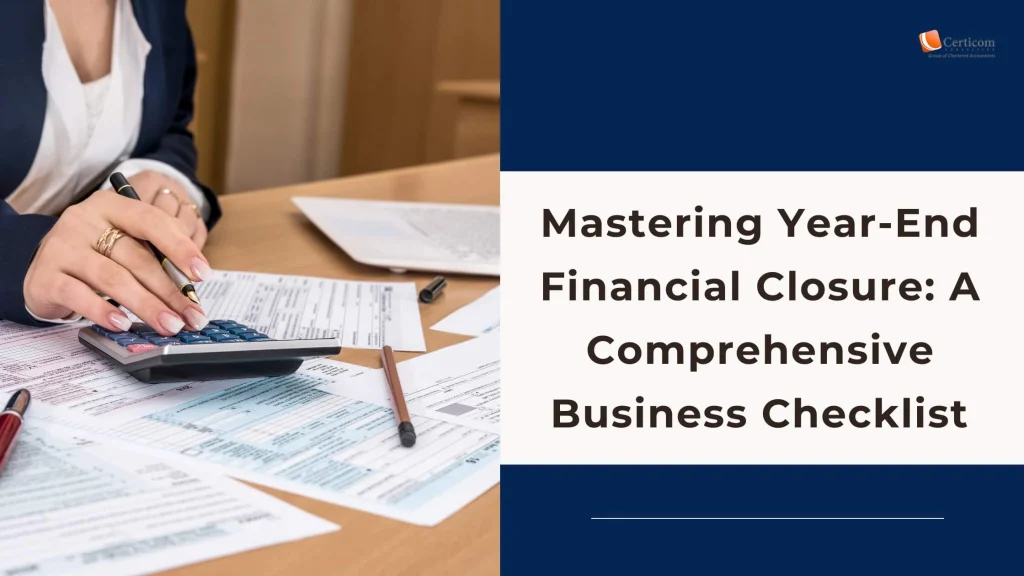


Mastering Year-End Financial Closure: A Comprehensive Business Checklist
As the financial year-end approaches, businesses must focus on financial accuracy, regulatory compliance, and strategic planning. A well-structured year-end review not only prevents penalties but also enhances financial stability and prepares companies for a seamless transition into the next fiscal year.
1. Essential Compliance Checks for a Smooth Year-End
a. Inventory and Asset Valuation
Conduct a physical stock verification to align recorded inventory with actual stock.
Adjust discrepancies in valuation to ensure accurate tax and profitability calculations.
Update depreciation schedules as per regulatory requirements.
b. Financial Reconciliations
Verify outstanding expenses and reclassify prepaid costs to align with the current fiscal year.
Obtain balance confirmations from suppliers, customers, and financial institutions.
Review foreign exchange balances and revalue them for accurate gains/losses.
c. Compliance with MSME Payments
- Ensure payments to Micro and Small Enterprises (MSMEs) are settled within the legally mandated period (15/45 days) to avoid penalties.
d. TDS and Tax Provisions Review
Deduct and deposit Tax Deducted at Source (TDS) for applicable expenses like audit fees and commissions.
Cross-check TDS records with Form 26AS and AIS to prevent mismatches.
2. GST Reconciliations and Regulatory Obligations
GST Compliance Checklist
Input Tax Credit (ITC): Match ITC claims with supplier filings and reverse ineligible credits.
Outward GST Liability: Reconcile sales records with GSTR-1 and GSTR-3B.
GST on Advances: Ensure proper tax treatment for service advances received.
Reverse Charge Mechanism (RCM): Verify if RCM obligations were met for services like imports.
LUT for Export: Renew the Letter of Undertaking for tax-free exports.
3. Preparing Financial Statements and Audit Readiness
Finalize financial statements incorporating necessary adjustments like depreciation and provisions.
Prepare for statutory audits in advance to avoid last-minute challenges.
Collaborate with Chartered Accountants to ensure accuracy and regulatory compliance.
4. Strategic Year-End Financial Planning
a. Optimizing Tax Planning Before March 31st
Finalize financial statements incorporating necessary adjustments like depreciation and provisions.
Prepare for statutory audits in advance to avoid last-minute challenges.
Collaborate with Chartered Accountants to ensure accuracy and regulatory compliance.
b. Ensuring Corporate Social Responsibility (CSR) Compliance
Verify that CSR contributions align with regulatory mandates and corporate objectives.
Non-compliance can lead to penalties or mandatory fund transfers.
c. Employee Benefits & Statutory Compliance
Reassess compliance with Provident Fund (PF), Employee State Insurance (ESI), and gratuity provisions.
Ensure all statutory employee benefits are accounted for and recorded accurately.
A Proactive Approach to Year-End Financial Success
Closing the financial year is not just about compliance—it’s an opportunity for strategic growth. A meticulous review of financial records, timely tax planning, and adherence to regulatory requirements empower businesses to enter the next fiscal year on a strong footing.
Engaging a Chartered Accountant ensures that businesses navigate year-end complexities with confidence, transforming financial closure into a strategic advantage.
Related Post
ITR Filing for Directors: Where Small Disclosure Gaps Create Big Risks
Tax Rules for Securities in AY 2026–27
Union Budget 2026–27: A Strategic Shift Toward Certainty, Simplicity, and Targeted Tax Policy
Book A One To One Consultation Now For FREE
How can we help? *