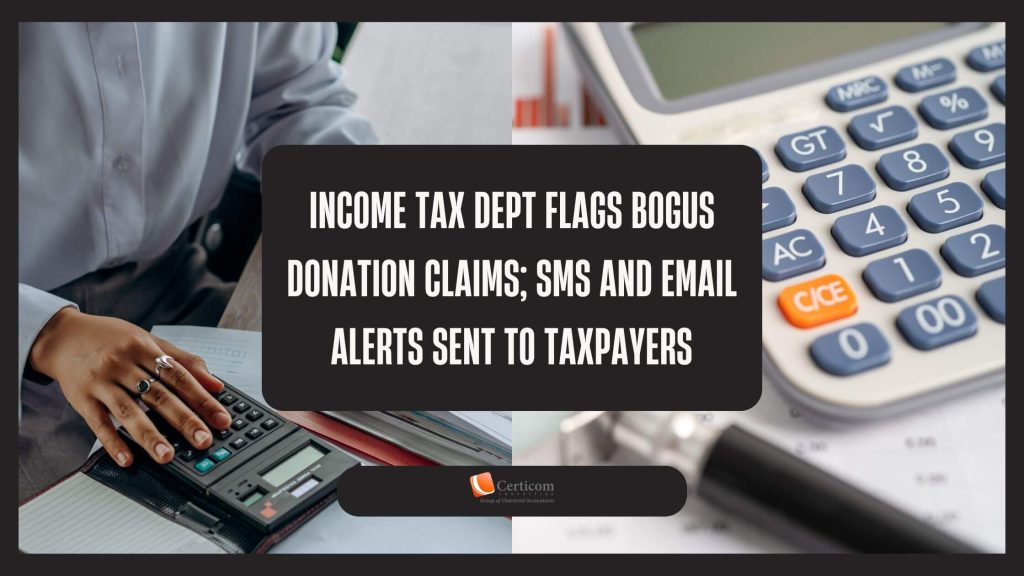

In a significant compliance-driven move, the Income Tax Department has intensified its action against fraudulent tax deduction claims linked to donations, particularly those routed through Registered Unrecognised Political Parties (RUPPs) and certain charitable institutions. As part of a taxpayer-friendly approach, the Department has begun sending SMS and email advisories urging affected taxpayers to review their returns and voluntarily correct any incorrect claims.
According to a notification issued by the Finance Ministry, the Income Tax Department has launched a targeted “NUDGE” campaign starting 12 December 2025. This initiative is designed as a preventive and corrective measure, allowing taxpayers an opportunity to update their Income Tax Returns (ITRs) and withdraw incorrect deductions before stricter enforcement actions are initiated.
The advisories are being sent to taxpayers’ registered mobile numbers and email IDs, highlighting potential issues in their claimed deductions and encouraging voluntary compliance.
The Ministry revealed that data analysis and investigation uncovered large-scale misuse of deduction provisions, particularly:
Bogus donation claims made to Registered Unrecognised Political Parties (RUPPs)
Fake or unverifiable donations to certain charitable institutions
Claims resulting in artificial reduction of tax liability and wrongful refunds
Further enforcement actions showed that many RUPPs involved were:
Non-filers of income tax returns
Non-operational at their registered addresses
Not engaged in any genuine political activity
Investigations also found that such entities were allegedly used for routing unaccounted funds, including hawala transactions, cross-border remittances, and issuance of fake donation receipts.
Search and survey operations conducted by the Department revealed incriminating evidence pointing to intermediaries who facilitated bogus donation claims. In some cases, individuals and companies were also found to have routed funds under the guise of donations and CSR activities, without any genuine charitable or political purpose.
The Central Board of Direct Taxes (CBDT) has highlighted that its data-driven risk assessment systems have identified suspicious claim patterns, especially under:
Section 80GGC – Deduction for donations made to political parties or electoral trusts, aimed at promoting transparency in political funding
Section 80G – Deduction for donations made to approved charitable funds, trusts, and institutions
Taxpayers claiming deductions under these sections are now subject to heightened scrutiny, particularly where the recipient entity’s credentials cannot be independently verified.
The Finance Ministry has advised taxpayers to take the following steps seriously:
Review past ITRs for any donation-related deductions claimed under Sections 80G or 80GGC
Verify the authenticity and approval status of the recipient political party or charitable institution
Withdraw incorrect claims voluntarily by filing an Updated Return, wherever applicable
Ensure that correct mobile numbers and email IDs are registered on the income tax portal to avoid missing important communications
Detailed guidance on deduction provisions and filing of Updated Returns is available on the official income tax portal.
While the current communication is positioned as a friendly compliance measure, it also signals the Department’s zero-tolerance approach to bogus claims. Taxpayers ignoring these advisories may face penalties, interest, reassessment proceedings, and prosecution in future enforcement actions.
The message is clear: voluntary correction today can prevent serious tax consequences tomorrow.
How can we help? *