Received an SMS or Email from the Income Tax Department? Here’s What It Really Means for Taxpayers (AY 2025–26)
If you have recently received an SMS or email from the Income Tax Departmentregarding your Income Tax Return (ITR), there is no cause for alarm. These communications are part of a routine, taxpayer-friendly initiative aimed at improving transparency and voluntary compliance.
With the last date for filing a belated return or revising an ITR for Assessment Year (AY) 2025–26 being 31 December 2025, the department is proactively nudging taxpayers to review their disclosures and rectify any mismatches, if required.
Why Is the Income Tax Department Sending These Messages?
The Income Tax Department has clarified that the recent SMS and email alerts are purely informational and advisory in nature. They are issued in cases where the data reported by third-party entities (such as banks, employers, mutual funds, or other reporting institutions) does not appear to fully align with the disclosures made by the taxpayer in their ITR.
These messages are not notices, summons, or penalty communications. Instead, they are intended to make taxpayers aware of transaction details already available with the department.
What Kind of Transactions Are Being Referred To?
The information highlighted in these communications is derived from data reported through various compliance mechanisms and reflected in the taxpayer’s:
Annual Information Statement (AIS)
Taxpayer Information Summary (TIS)
The alerts are sent only when there appears to be a significant gap between the income or transactions disclosed in the ITR and the information received from reporting entities during the relevant financial year.
Official Clarification from the Income Tax Department
According to the department, these communications are designed to:
Facilitate taxpayers by sharing transaction information available with the Income Tax Department
Enable taxpayers to review and reconcile discrepancies, if any
Encourage voluntary correction without triggering enforcement action
The department has emphasized that the intent is assistance, not enforcement.
What Should Taxpayers Do After Receiving Such a Message?
Taxpayers are advised to take the following steps:
Review your AIS and TIS carefully Log in to the income tax e-filing portal and cross-check all reported transactions.
Submit feedback on the Compliance Portal If any transaction is incorrect, duplicated, or does not belong to you, feedback can be submitted online.
Revise your return, if required If genuine income or transactions were omitted or incorrectly reported, a revised return should be filed.
File a belated return, if not filed yet Taxpayers who have not filed their return at all can still file a belated return within the prescribed timeline.
Ignore the communication if everything is accurate If your ITR disclosures are complete and correct, no action is required.
Important Due Date to Remember
Last date for filing a belated return or revising an ITR for AY 2025–26: 31 December 2025
Taxpayers are encouraged to act promptly where discrepancies exist, as timely voluntary compliance helps avoid future notices, interest, or penalties.
An SMS or email from the Income Tax Department is not a reason to panic. It is a compliance facilitation measure that provides taxpayers with an opportunity to review, correct, and regularize their tax filings voluntarily. Staying proactive, reviewing AIS data, and responding appropriately can help ensure smooth and hassle-free tax compliance.
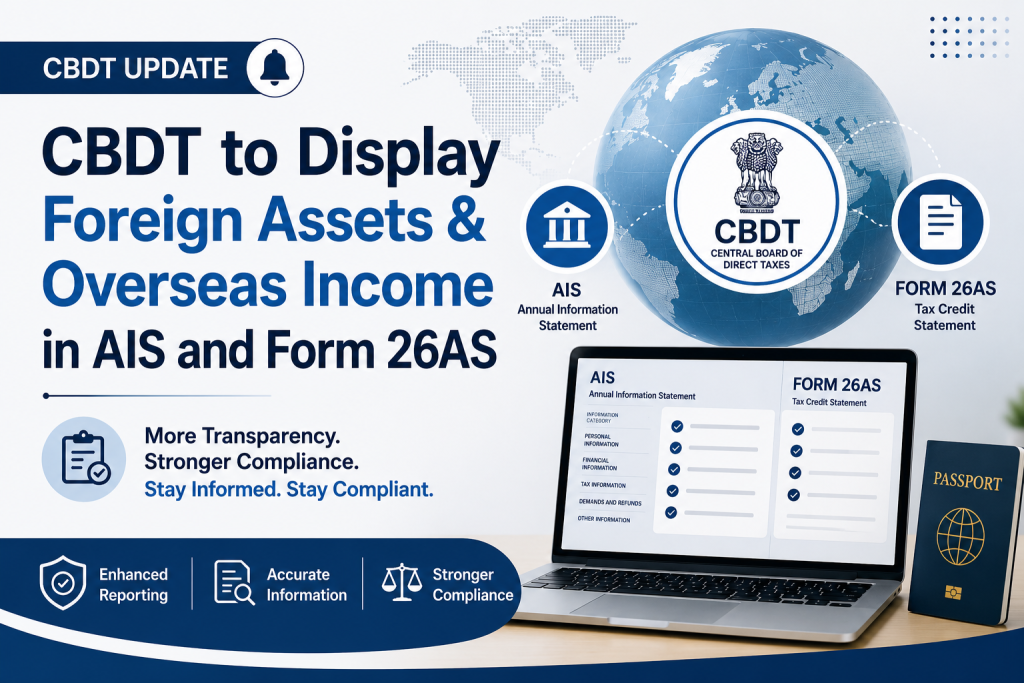
CBDT to Display Foreign Assets & Overseas Income in AIS and Form 26AS On 8 July 2026, the Central Board of Direct Taxes (CBDT) issued a landmark directive (Order F.No.…
ITR-1 vs ITR-2 vs ITR-4 for AY 2026-27: How to Choose the Right Income Tax Return Form Filing your Income Tax Return (ITR) begins with one critical decision—selecting the correct…
Who Qualifies as a Relative Under the Income-tax Act, 1961? The term "relative" may appear straightforward, but under the Income-tax Act, 1961, it does not have a single universal definition.…