


GST Registration: A Detailed Guide to Rules, Regulations, and Procedures

gst

GST Registration: A Detailed Guide to Rules, Regulations, and Procedures

gst

Securing a GSTIN (Goods and Services Tax Identification Number) is one of the first compliance steps for businesses operating in India. GST registration is more than just filling out a form—it formally integrates your business into the Goods and Services Tax network, enabling you to legally collect GST, claim Input Tax Credit (ITC), and operate within a unified national tax system.

Under the Central Goods and Services Tax Act, 2017 (CGST Act) and corresponding State/UT laws, registration is not a mere formality but a statutory obligation. It lays the foundation for lawful participation in GST, while also ensuring businesses remain transparent and accountable in their tax practices.

For many new entrepreneurs, the process can feel overwhelming—questions often arise around who needs to register, how to register, and how cancellation or revocation works. This article provides a clear, structured, and legally backed guide to the complete lifecycle of GST registration, making it a reliable reference for law students, tax professionals, and business owners.

gst

Who is Liable to Register Under GST?

The liability to register under GST is governed by Sections 22, 23, and 24 of the CGST Act, 2017.

Threshold-Based Registration (Section 22)

Businesses must register if their aggregate turnover exceeds prescribed limits:

  • ₹20 lakhs for service providers (₹10 lakhs in special category states).

  • ₹40 lakhs for suppliers of goods, subject to conditions.

This threshold ensures that smaller businesses are not overburdened by compliance.

Compulsory Registration (Section 24)

Certain categories of persons must register irrespective of turnover. These include:

  • Inter-state suppliers of goods.

  • Casual taxable persons.

  • Non-resident taxable persons.

  • Persons liable under reverse charge mechanism.

  • E-commerce operators and suppliers through such platforms.

This provision ensures wider coverage and prevents revenue leakages.

Persons Exempt from Registration (Section 23)

Certain persons are not required to register, such as:

  • Suppliers dealing exclusively in exempt or non-taxable goods/services.

  • Agriculturists, to the extent of supply of produce out of cultivation of land.

These carve-outs safeguard non-taxable entities from unnecessary compliance burdens.

Procedure for GST Registration

GST registration is completely digital and carried out through the GST Common Portal. The process includes:

  1. Preliminary Application – Submission of PAN, mobile number, and email to generate a Temporary Reference Number (TRN).

  2. Detailed Information – Filling in business details and uploading required documents (proof of business, bank details, photographs, etc.).

  3. Verification – The GST officer scrutinizes the application.

  4. Approval & GSTIN Issuance – On successful verification, a unique 15-digit GSTIN is issued, which becomes the business’s official tax identity.

Cancellation of GST Registration

Under Section 29 of the CGST Act, registration may be cancelled either by the proper officer or on the taxpayer’s request.

Suo Moto Cancellation by Officer

An officer may cancel GST registration if:

  • The business has ceased operations.

  • Returns are not filed for a continuous period (e.g., 6 months for regular taxpayers).

  • The registration was obtained fraudulently.

Voluntary Cancellation by Taxpayer

A registered person can apply for cancellation if:

  • The business is discontinued or transferred.

  • Turnover falls below the registration threshold.

Revocation of GST Registration

If a registration is cancelled by the tax officer, the taxpayer can seek revocation under Section 30 of the CGST Act.

Revocation Process:

  • Application must be filed within 30 days of the cancellation order.

  • The taxpayer must file pending returns and rectify the default.

  • The officer reviews the application and, if satisfied, restores the GSTIN.

This provision ensures businesses that default unintentionally can re-enter the GST system upon compliance.

Conclusion

The GST registration framework is designed to strike a balance between compliance and ease of doing business. From determining liability to registration, cancellation, and revocation, each step is backed by statutory clarity.

For professionals and students of tax law, understanding this lifecycle is more than academic—it is essential for advising businesses, ensuring compliance, and navigating the dynamic field of indirect taxation. With its emphasis on digital processes and uniformity, GST has modernized India’s indirect tax regime, making registration and compliance a cornerstone of participation in the national market.

Related Post

image

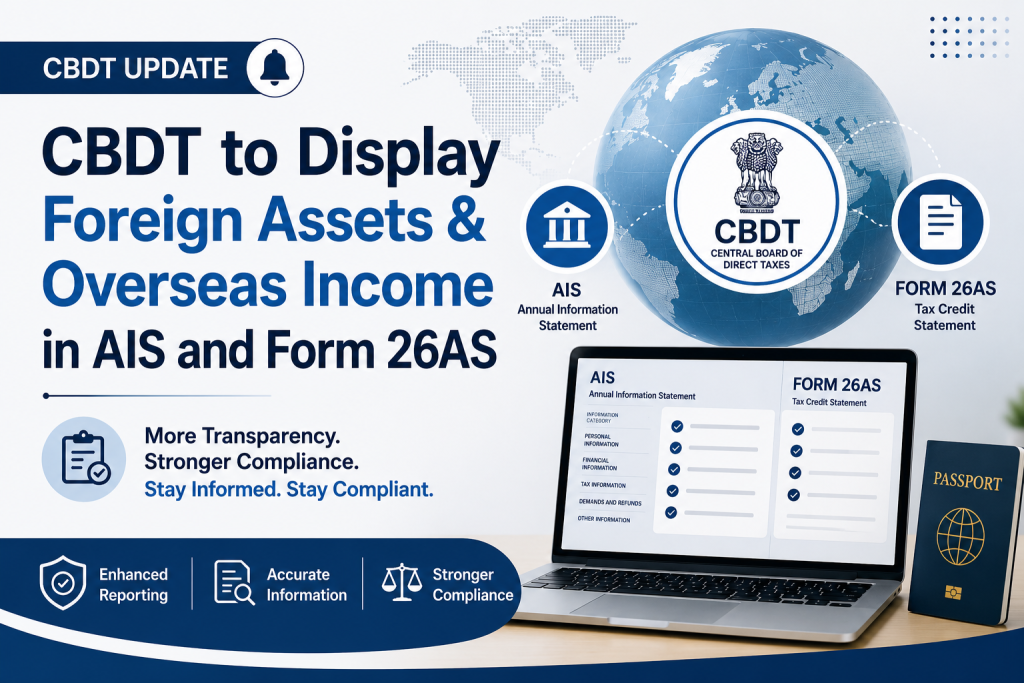
CBDT to Display Foreign Assets & Overseas Income in AIS and Form 26AS

CBDT to Display Foreign Assets & Overseas Income in AIS and Form 26AS On 8 July 2026, the Central Board of Direct Taxes (CBDT) issued a landmark directive (Order F.No.…
image

ITR-1 vs ITR-2 vs ITR-4 for AY 2026-27: How to Choose the Right Income Tax Return Form

ITR-1 vs ITR-2 vs ITR-4 for AY 2026-27: How to Choose the Right Income Tax Return Form Filing your Income Tax Return (ITR) begins with one critical decision—selecting the correct…
image

Who Qualifies as a Relative Under the Income-tax Act, 1961?

Who Qualifies as a Relative Under the Income-tax Act, 1961? The term "relative" may appear straightforward, but under the Income-tax Act, 1961, it does not have a single universal definition.…


Book A One To One Consultation Now
For FREE

How can we help? *

Registering for GST in 2025? Follow These Easy Steps

GST

Registering for GST in 2025? Follow These Easy Steps

GST

Introduction – Why GST Still Matters in 2025

The Goods and Services Tax (GST), introduced on 1 July 2017, was a landmark reform that unified India’s indirect taxation system under the principle of “One Nation, One Tax.”

Now in 2025, GST has evolved into a far more streamlined and technology-driven system. Whether you are a local shop owner, freelancer, startup founder, or e-commerce seller, GST registration is a critical requirement if your business crosses the prescribed turnover threshold or involves interstate supply of goods and services.

Even if your business does not mandatorily require GST registration, many entrepreneurs opt for voluntary registration to avail input tax credit (ITC) benefits and boost business credibility.

This guide explains everything you need to know in 2025 — eligibility, documentation, latest rules, registration process, fees, mistakes to avoid, and post-registration compliance.

Eligibility Criteria for GST Registration in 2025

According to the latest GST norms, eligibility depends primarily on your annual turnover and nature of business:

Business TypeNormal StatesSpecial Category States
Goods Suppliers₹40 Lakhs₹20 Lakhs
Service Providers₹20 Lakhs₹10 Lakhs

Mandatory GST Registration Cases

  • Interstate supply of goods or services

  • Selling through e-commerce platforms (Amazon, Flipkart, Meesho, etc.)

  • Supply covered under the reverse charge mechanism

  • Non-resident taxable persons

  • Input Service Distributors (ISD)

👉 Even below the threshold, voluntary registration can help you claim ITC and enhance customer trust.

Documents Required for GST Registration in 2025

For Proprietorship

  • PAN & Aadhaar of proprietor

  • Passport size photo

  • Business address proof (Electricity bill, Rent Agreement, NOC)

  • Bank proof (Cancelled cheque/statement)

For Partnership/LLP

  • Partnership deed / LLP agreement

  • PAN of firm & partners

  • Aadhaar of partners

  • Business address proof

  • Bank details

For Private Limited Company

  • Certificate of Incorporation

  • PAN of company & directors

  • Aadhaar of directors

  • Board resolution authorizing GST application

  • Office address proof

  • Bank details

Step-by-Step GST Registration Process (2025)

You can apply yourself via the GST portal or hire professional support (like LegalDev) for faster processing.

DIY Process (Through GST Portal)

  1. Visit the official portal – www.gst.gov.in

  2. Navigate: Services → Registration → New Registration

  3. Part A: Enter PAN, Mobile, and Email → Verify via OTP → Get TRN (Temporary Reference Number)

  4. Part B: Login with TRN → Fill in business, promoter, address, and bank details

  5. Upload required documents

  6. Complete Aadhaar authentication or apply via DSC (for companies)

  7. Submit application → ARN generated

  8. GST Officer verification (normally within 3–7 working days)

  9. On approval, GSTIN certificate is sent via Email/SMS

GST Registration Fees & Timelines

ModeGovt. FeeProcessing Time
Self-RegistrationFree5–7 working days
Through CA/LegalDev₹590 – ₹1,9993–4 working days

There are no government charges for GST registration. Delays generally occur due to document mismatches or officer clarifications.

Common Mistakes to Avoid in 2025

  • Selecting the wrong business category

  • PAN & Aadhaar name mismatch

  • Using outdated/incomplete address proof

  • Skipping Aadhaar authentication

  • Uploading unclear/high-size documents

Tip: Professional verification services prevent rejections caused by such avoidable errors.

GST

Latest GST Registration Rules (2025)

  • Aadhaar authentication is mandatory for all new applicants

  • Late registration penalty: ₹10,000 or the tax amount (whichever is higher)

  • Stricter compliance rules for e-commerce sellers

  • Faster approvals for voluntary registrations

Post-Registration GST Compliance

Once registered, you must:

  • File GSTR-1 & GSTR-3B monthly or quarterly

  • Issue GST invoices in prescribed format

  • Follow rules for Input Tax Credit (ITC)

  • File annual GST returns

Non-compliance may result in penalties or cancellation of GSTIN.

Related Post

image

CBDT to Display Foreign Assets & Overseas Income in AIS and Form 26AS

CBDT to Display Foreign Assets & Overseas Income in AIS and Form 26AS On 8 July 2026, the Central Board of Direct Taxes (CBDT) issued a landmark directive (Order F.No.…
image

ITR-1 vs ITR-2 vs ITR-4 for AY 2026-27: How to Choose the Right Income Tax Return Form

ITR-1 vs ITR-2 vs ITR-4 for AY 2026-27: How to Choose the Right Income Tax Return Form Filing your Income Tax Return (ITR) begins with one critical decision—selecting the correct…
image

Who Qualifies as a Relative Under the Income-tax Act, 1961?

Who Qualifies as a Relative Under the Income-tax Act, 1961? The term "relative" may appear straightforward, but under the Income-tax Act, 1961, it does not have a single universal definition.…

Book A One To One Consultation Now
For FREE

How can we help? *

Know About New GST Registration Process – Aadhaar Authentication

1. w.e.f. 21st August, 2020, undergo authentication of Aadhaar number and the date of submission of the application in such cases shall be the date of authentication of the Aadhaar number, or 15 days from the submission of the application in Part B of FORM GST REG-01 whichever is earlier”.

2. Fails to undergo authentication of Aadhaar number as or does not opt for authentication of Aadhaar number, the registration shall be granted only after physical verification of the place of business in the presence of the person.

gst

3. As per Point No. 2, Notice in FORM GST REG-03 may be issued not later than twenty one days from the date of submission of the application.

4. Registration deemed to be granted if proper officer fails to take any action in 3 days/15 days/21 days/7 days as the case may be.


Recent Post:-