GST Registration: A Detailed Guide to Rules, Regulations, and Procedures

gst

GST Registration: A Detailed Guide to Rules, Regulations, and Procedures

gst

Securing a GSTIN (Goods and Services Tax Identification Number) is one of the first compliance steps for businesses operating in India. GST registration is more than just filling out a form—it formally integrates your business into the Goods and Services Tax network, enabling you to legally collect GST, claim Input Tax Credit (ITC), and operate within a unified national tax system.

Under the Central Goods and Services Tax Act, 2017 (CGST Act) and corresponding State/UT laws, registration is not a mere formality but a statutory obligation. It lays the foundation for lawful participation in GST, while also ensuring businesses remain transparent and accountable in their tax practices.

For many new entrepreneurs, the process can feel overwhelming—questions often arise around who needs to register, how to register, and how cancellation or revocation works. This article provides a clear, structured, and legally backed guide to the complete lifecycle of GST registration, making it a reliable reference for law students, tax professionals, and business owners.

gst

Who is Liable to Register Under GST?

The liability to register under GST is governed by Sections 22, 23, and 24 of the CGST Act, 2017.

Threshold-Based Registration (Section 22)

Businesses must register if their aggregate turnover exceeds prescribed limits:

  • ₹20 lakhs for service providers (₹10 lakhs in special category states).

  • ₹40 lakhs for suppliers of goods, subject to conditions.

This threshold ensures that smaller businesses are not overburdened by compliance.

Compulsory Registration (Section 24)

Certain categories of persons must register irrespective of turnover. These include:

  • Inter-state suppliers of goods.

  • Casual taxable persons.

  • Non-resident taxable persons.

  • Persons liable under reverse charge mechanism.

  • E-commerce operators and suppliers through such platforms.

This provision ensures wider coverage and prevents revenue leakages.

Persons Exempt from Registration (Section 23)

Certain persons are not required to register, such as:

  • Suppliers dealing exclusively in exempt or non-taxable goods/services.

  • Agriculturists, to the extent of supply of produce out of cultivation of land.

These carve-outs safeguard non-taxable entities from unnecessary compliance burdens.

Procedure for GST Registration

GST registration is completely digital and carried out through the GST Common Portal. The process includes:

  1. Preliminary Application – Submission of PAN, mobile number, and email to generate a Temporary Reference Number (TRN).

  2. Detailed Information – Filling in business details and uploading required documents (proof of business, bank details, photographs, etc.).

  3. Verification – The GST officer scrutinizes the application.

  4. Approval & GSTIN Issuance – On successful verification, a unique 15-digit GSTIN is issued, which becomes the business’s official tax identity.

Cancellation of GST Registration

Under Section 29 of the CGST Act, registration may be cancelled either by the proper officer or on the taxpayer’s request.

Suo Moto Cancellation by Officer

An officer may cancel GST registration if:

  • The business has ceased operations.

  • Returns are not filed for a continuous period (e.g., 6 months for regular taxpayers).

  • The registration was obtained fraudulently.

Voluntary Cancellation by Taxpayer

A registered person can apply for cancellation if:

  • The business is discontinued or transferred.

  • Turnover falls below the registration threshold.

Revocation of GST Registration

If a registration is cancelled by the tax officer, the taxpayer can seek revocation under Section 30 of the CGST Act.

Revocation Process:

  • Application must be filed within 30 days of the cancellation order.

  • The taxpayer must file pending returns and rectify the default.

  • The officer reviews the application and, if satisfied, restores the GSTIN.

This provision ensures businesses that default unintentionally can re-enter the GST system upon compliance.

Conclusion

The GST registration framework is designed to strike a balance between compliance and ease of doing business. From determining liability to registration, cancellation, and revocation, each step is backed by statutory clarity.

For professionals and students of tax law, understanding this lifecycle is more than academic—it is essential for advising businesses, ensuring compliance, and navigating the dynamic field of indirect taxation. With its emphasis on digital processes and uniformity, GST has modernized India’s indirect tax regime, making registration and compliance a cornerstone of participation in the national market.

Related Post

image

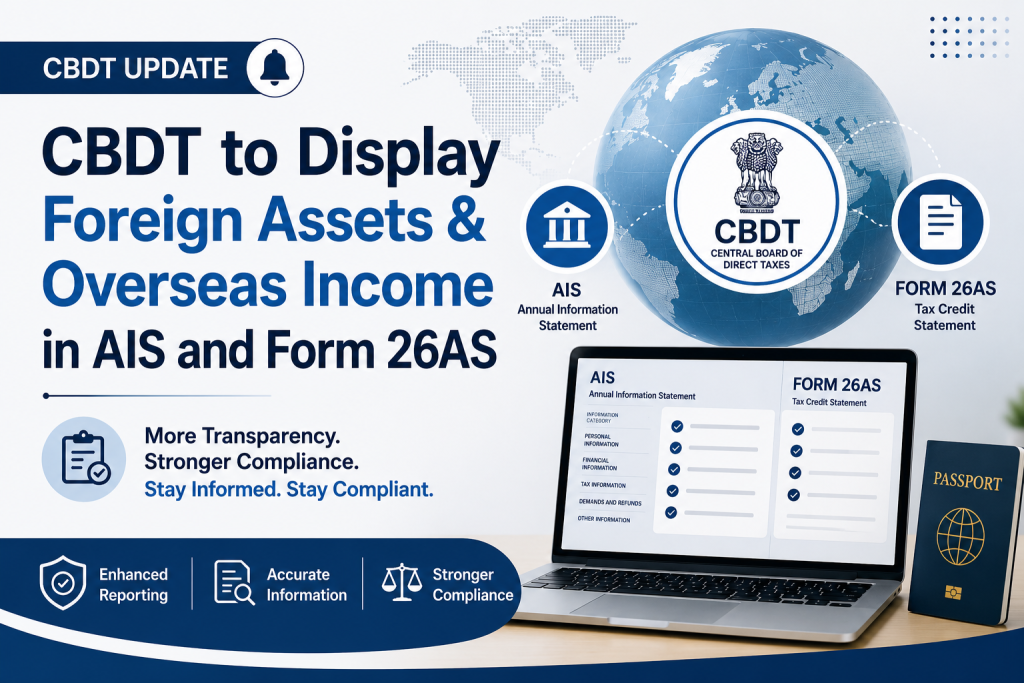
CBDT to Display Foreign Assets & Overseas Income in AIS and Form 26AS

CBDT to Display Foreign Assets & Overseas Income in AIS and Form 26AS On 8 July 2026, the Central Board of Direct Taxes (CBDT) issued a landmark directive (Order F.No.…
image

ITR-1 vs ITR-2 vs ITR-4 for AY 2026-27: How to Choose the Right Income Tax Return Form

ITR-1 vs ITR-2 vs ITR-4 for AY 2026-27: How to Choose the Right Income Tax Return Form Filing your Income Tax Return (ITR) begins with one critical decision—selecting the correct…
image

Who Qualifies as a Relative Under the Income-tax Act, 1961?

Who Qualifies as a Relative Under the Income-tax Act, 1961? The term "relative" may appear straightforward, but under the Income-tax Act, 1961, it does not have a single universal definition.…

Book A One To One Consultation Now
For FREE

How can we help? *

Most recent amendments in GST Rules

1. Rule 10A has been embedded – Taxpayers are required to outfit bank account data on the entryway within 45 days of the grant of resignation or the due date of GSTR-3B, whichever is prior.

Compelling date = 28 June 2019;

2.Rule 21 has been amended –  GST registration is subject to be dropped of an individual not furnishing the details required according to Rule 10A alluded previously.

Compelling date = 28 June 2019.

3. Rule 32A has been embedded – For the reason for charging GST, the estimation of supply of good or services will exclude the estimation of Kerala Flood Cess charged consequently.

Viable date = 1st July 2019.

4. Rule 46 and Rule 49 has been amended- A stipulation has been embedded to give the necessity of Quick Response (QR) code on tax invoice and bill of supply, subject to specific conditions and confinements, as might be indicated.

Viable date = To be Notified.

5. Rule 66(2), 67(2) and 87(9) has been amended- Rules identifying with the strategy of claiming TDS/TCS deducted has been amended.

Viable date = 28 June 2019.

6. Rule 87 has been altered – another Sub-rule 13 has been embedded to give that an enrolled individual can move any measure of expense/premium/punishment/charge to some other head in the electronic cash ledger, in such manner, structure GST PMT-09 has also been presented.

Compelling date = To be Notified.

7. Rule 95A has been embedded – Rule 95A has been embedded to give the discount mechanism to the retail outlets built up in the takeoff region of an International Airport. In such manner, form GST RFD-10B has likewise been presented.

Viable date = 01st July 2019.

8. Rule 128, 129, 132 and 133 have been corrected – Rules identifying with anti-profiteering has been altered.

Successful date = 28 June 2019.

9. Rule 138(10) and 138 have been altered – Proviso has been embedded to give that the legitimacy of e-way bill might be reached out within eight hours from the time of its expiry. Standard 138E has been revised to give that taxpayers asserting the advantage of notice number 02/2019-Central Tax dated 07 March 2019 will not be permitted to fill form GST EWB-01 if the return has not been filed for two back to back quarters.

Compelling date = 28 June 2019.

10. Amendment to GSTR-9 format:- Tables of Annual Return has been corrected to give the details from April 2018 to March 2019 rather than April 2018 to September 2018; Instructions of table 8A has been changed to give that FORM GSTR-2A created on 1 May 2019 will be auto-populated in table 8A.

Formats of Forms REG-01, REG-07, REG-12, GSTR-04, RFD-05 and DRC-03 have also been changed to suit the corrections.

Viable date = 28 June 2019.