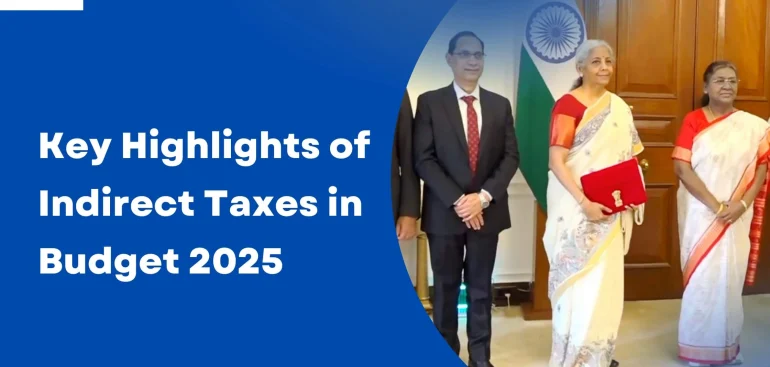
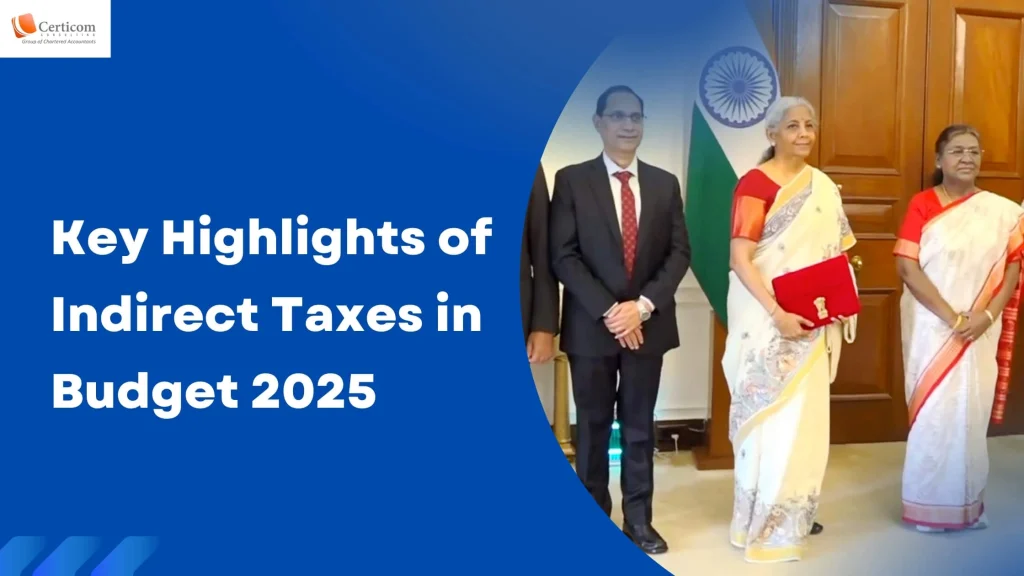
Key Highlights of Indirect Taxes in Budget 2025

Indirect Taxes

Key Highlights of Indirect Taxes in Budget 2025

Indirect Taxes

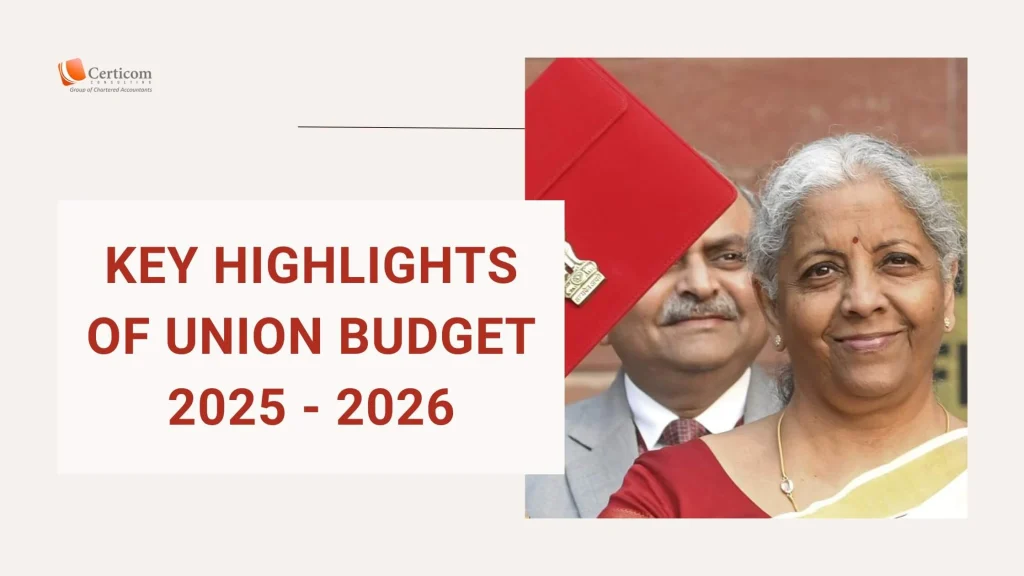
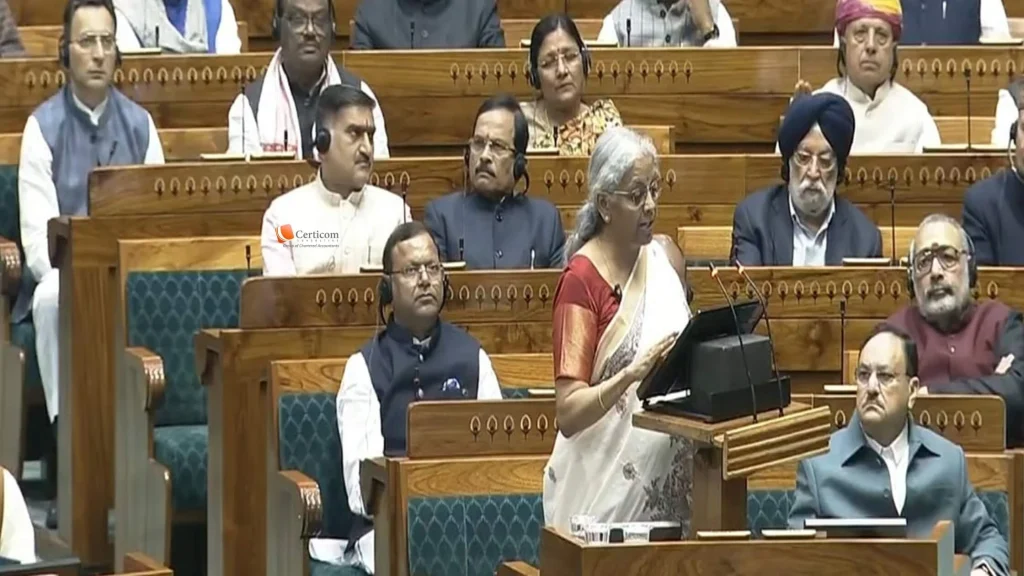
The Budget 2025 session commenced on January 31, 2025, with the President of India’s address and the presentation of the Economic Survey 2024-25. The survey forecasts India’s GDP growth for FY 2026 to be between 6.3% and 6.8%, citing strong economic fundamentals. With a median age of 28 years, India is poised to become the world’s third-largest economy by 2030. The budget aims to drive economic growth, promote inclusive development, boost private sector investments, and enhance household purchasing power. It is designed to unlock the nation’s potential for global economic prominence and long-term prosperity.

Indirect Taxes – Customs

Customs Tariff & Legislative Changes

  • Amendments in Customs tariff rates and Harmonized System of Nomenclature (HSN) codes.

  • Revisions in the Customs Act, 1962 and Customs Tariff Act, 1975.

  • Rationalization of tariff structure for industrial goods, reducing seven tariff rates.

  • Limitation of cess/surcharge to a single levy.

Import & Export Adjustments

  • Introduction of voluntary revision of entries after clearance of goods for importers/exporters.

  • Relief measures on the import of drugs and medicines.

  • Promotion of domestic manufacturing and value addition in minerals, textiles, electronics, lithium-ion batteries, shipping, and telecom sectors.

  • Export incentives for handicrafts, leather, and marine products.

Time Limits & Exemptions

  • Provisional assessments now have a two-year limit, extendable by one year.

  • End-use conditions for inputs extended up to one year.

  • Exemptions and concessional rates under Notification No. 50/2017 – Customs (30.06.2017) extended until March 31, 2029, covering:

    • Bulk drugs for medicine manufacturing.

    • Bulk drugs for polio vaccines and mono-component insulins.

    • Drugs, medicines, and special foods for rare disease treatment.

    • 37 additional drugs and 13 new Patient Assistance Programs (PAP) added to the zero-duty list.

Tariff Reductions (Effective May 1, 2025)

  • Pharmaceutical Reference Standards & Certified Reference Materials (HS Code: 3822 90): Reduced from 30% to 10%.

  • Sorbitol (HS Code: 3824 60): Reduced from 30% to 20%.

Indirect Taxes – Goods & Services Tax (GST)

Revenue Estimates

  • CGST/IGST revised estimates for FY 2024-25: ₹6,506.46 crore.

  • Budget estimate for FY 2025-26: ₹6,870.52 crore.

Key Legislative Amendments to the CGST Act, 2017

  • Definitions (Section 2):

    • Revised definition of Input Service Distributor to cover interstate supplies taxed under reverse charge.

    • Inclusion of explanations for ‘Local Fund’ and ‘Municipal Fund’ under the definition of ‘Local Authority’.

    • Addition of a new clause defining Unique Identification Marking for Track & Trace Mechanism.

  • Time of Supply (Sections 12 & 13):

    • Omission of provisions related to the time of supply for vouchers.

  • Input Tax Credit (Section 17):

    • Modification of wording from ‘plant or machinery’ to ‘plant and machinery’ (effective July 1, 2017).

  • Input Service Distributor (Section 20):

    • Explicit provision for ITC distribution for interstate supplies taxed under reverse charge.

    • Effective from April 2025.

  • Credit Note (Section 34):

    • Mandatory reversal of ITC by recipients when suppliers reduce tax liability via credit notes.

  • Returns (Section 38 & 39):

    • Removal of ‘auto-generated’ references.

    • More inclusive ITC statement format.

    • Enabling conditions for return filing.

Indirect Taxes
  • Appeals & Pre-deposits (Sections 107 & 112):

    • 10% mandatory pre-deposit for penalty-only cases before appellate bodies.

  • Track & Trace Mechanism (New Sections 122B & 148A):

    • Introduction of penalties for non-compliance with Track & Trace requirements.

    • Enabling provisions for specified commodity tracking.

  • Non-Supply Transactions (Schedule III):

    • New entry for goods warehoused in SEZs or Free Trade Warehousing Zones (FTWZs) to be treated as neither goods nor services before clearance.

    • Clarifications on tax applicability and non-refund provisions for such transactions.

    • Effective July 1, 2017.

Implementation Timeline

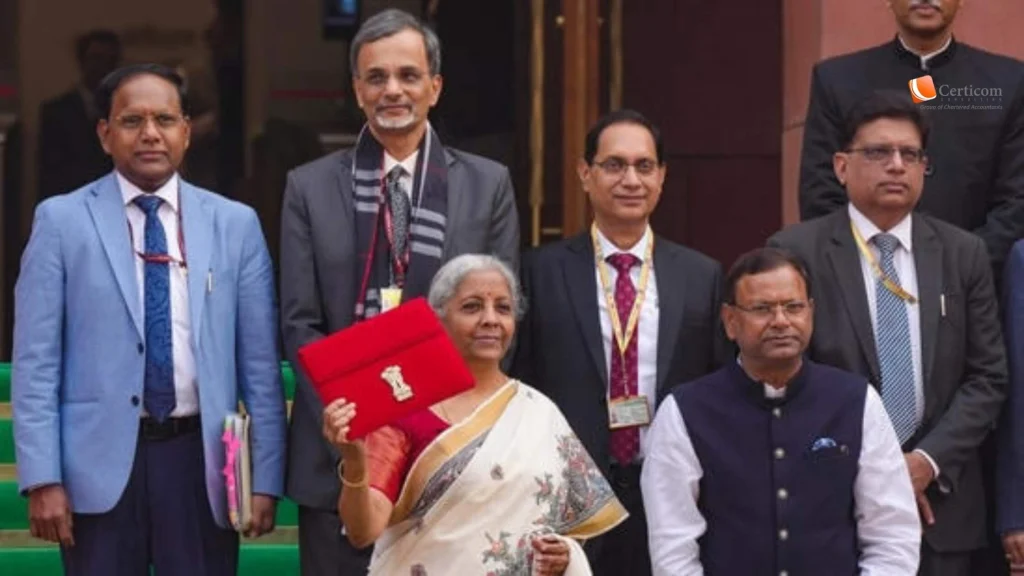
The above amendments will take effect upon enactment of the Finance Bill, 2025, unless otherwise specified.

This budget reflects the government’s commitment to economic stability, ease of doing business, and robust trade policies, with a strong focus on manufacturing, healthcare, and export-driven industries.

Related Post

image

GST 2.0 and Recent Reforms: What Taxpayers Need to Know

GST 2.0 and Recent Reforms: What Taxpayers Need to Know Since its rollout in 2017, India’s Goods and Services Tax (GST) has undergone continuous refinement. Each reform initiative has focused…
image

Revised ITR: Does the Deadline Extend If CPC Delays Processing?

Revised ITR: Does the Deadline Extend If CPC Delays Processing? As the year-end approaches, many taxpayers are anxious. A significant number of income tax returns (ITRs) for AY 2025–26 remain…
image

Smart HUF Tax Planning: Proper Structuring and Protection Against Clubbing

Smart HUF Tax Planning: Proper Structuring and Protection Against Clubbing A Hindu Undivided Family (HUF) can be an efficient tax planning vehicle when it is created correctly and operated with…

Book A One To One Consultation Now
For FREE

How can we help? *

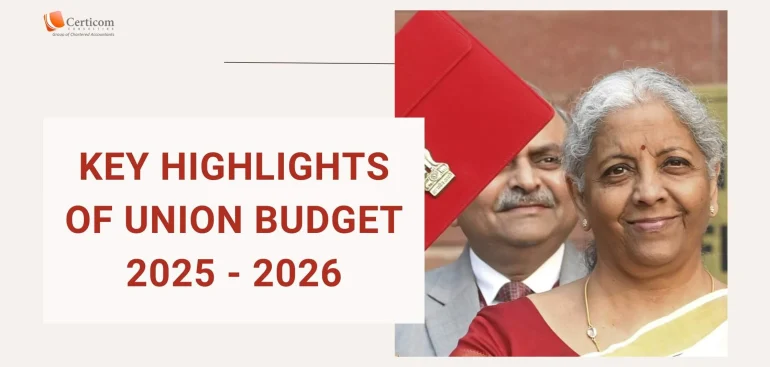
Key Highlights of Union Budget 2025 – 2026

Budget

Key Highlights of Union Budget 2025 - 2026

Budget

Union Finance Minister Nirmala Sitharaman presented her eighth budget on February 1, 2025, introducing major reforms aimed at benefiting the middle class, MSMEs, startups, and various industries. Key measures include tax exemptions, credit availability expansion, and sector-specific initiatives.

Tax Reforms and Relief

  • New Tax Regime: Incomes up to ₹12 lakh are now tax-free, providing significant relief to taxpayers.

  • Tax Deduction for Senior Citizens: Deduction limit doubled from ₹50,000 to ₹1 lakh.

  • Increase in TDS on Rent: Annual limit for TDS on rent increased from ₹2.4 lakh to ₹6 lakh.

  • Extended Time for Filing Updated Returns: Time extended from 2 years to 4 years.

Revised Income Tax Slabs

Income Range (₹)Tax Rate (%)
0 – 4 lakh0%
4 – 8 lakh5%
8 – 12 lakh10%
12 – 16 lakh15%
16 – 20 lakh20%
20 – 24 lakh25%
Above 24 lakh 
Budget

MSME & Entrepreneurship Support

  • Credit Cards for Micro Enterprises: Micro enterprises registered on the Udyam portal will receive customized credit cards with a ₹5 lakh limit.

  • Credit Guarantee Expansion: Cover for MSMEs increased from ₹5 crore to ₹10 crore, aiming to provide ₹1.5 lakh crore in credit over five years.

Revised MSME Classification


CategoryInvestment Limit (Current/₹ Cr)Revised (₹ Cr)Turnover Limit (Current/₹ Cr)Revised (₹ Cr)
Micro12.5510
Small102550100
Medium50125250500
  • First-Time Entrepreneurs Scheme: Term loans of up to ₹2 crore for 5 lakh new entrepreneurs, including women and marginalized groups.

  • Support for Labour-Intensive Sectors:

    • Footwear & Leather: Aiming to create 22 lakh jobs with a ₹4 lakh crore turnover.

    • Toy Industry: Positioning India as a global hub for sustainable toy manufacturing.

    • Food Processing: Establishment of a National Institute of Food Technology in Bihar.

Manufacturing & Export Promotion

  • National Manufacturing Mission: Focus on Ease of Business, Workforce Development, MSME Growth, Technology, and Quality Products.

  • Clean Tech Manufacturing: Emphasis on domestic production of solar PV cells, EV batteries, wind turbines, and grid-scale batteries.

  • Export Promotion Mission: Easier access to export credit and support for MSMEs in tackling non-tariff barriers.

  • BharatTradeNet (BTN): A unified digital platform to streamline international trade documentation.

  • Industry 4.0 & Global Capability Centres (GCC): Establishing a framework to promote tech talent and employment in Tier-2 cities.

  • Warehousing for Air Cargo: Streamlining customs and logistics for high-value exports.

Indirect Tax Reforms

  • Customs Duty Rationalization: Seven tariff rates removed, leaving only eight.

  • GST Amendments:

    • Reverse Charge Mechanism (RCM): Input Service Distributor (ISD) can distribute input tax credit on RCM supplies.

    • Extended Compliance Timelines:

      • Time limit for export of handicrafts increased from 6 months to 1 year.

      • Export of repaired foreign-origin goods extended from 6 months to 1 year.

  • Sector-Specific Duty Reductions:

    • Pharmaceuticals: 36 lifesaving drugs exempt from Basic Customs Duty.

    • Electronics: BCD on Interactive Flat Panel Displays increased to 20%, with exemptions for Open Cell TV parts.

    • Shipping & Telecommunications: Extended BCD exemptions for shipbuilding and reduced BCD on Ethernet switches.

TDS/TCS Rationalization

  • Higher Thresholds:

    • Senior Citizens: Interest income exemption doubled from ₹50,000 to ₹1 lakh.

    • Rental Income: TDS threshold increased from ₹2.4 lakh to ₹6 lakh.

  • TCS Changes:

    • Higher LRS Remittance Limit: Increased from ₹7 lakh to ₹10 lakh.

    • TCS Exemption for Education Loans: No TCS on education remittances funded by loans.

Reduction in TDS Rates


SectionDescriptionCurrent RateProposed Rate
194LBCIncome from securitization trust25% (Individual/HUF), 30% (Others)10%
206C(1)TCS on timber/forest produce2.5%2%


Ease of Doing Business Initiatives in Budget 2025

1. Streamlining Transfer Pricing Regulations: A new scheme will determine the arm’s length price of international transactions for a block period of three years instead of yearly examinations.

2. Expansion of Safe Harbour Rules (SHR): Predefined margins for international transactions will be expanded to reduce litigation and provide tax certainty.

3. Relief for Senior Citizens with Old National Savings Scheme (NSS) Accounts:

Withdrawals made on or after August 29, 2024, will be tax-exempt.

4. NPS Vatsalya accounts will receive similar tax treatment as regular NPS accounts, subject to overall limits.

5. Digitalization of Appellate Order Processing: Within two years, all tax-related appellate orders will be fully digitalized and paperless, as promised in the July 2024 Budget.

Budget

Other Highlighs announced in Union Budget 2025

1. Grameen Credit Score Framework: A new framework for rural India’s credit scoring.

2. FDI in Insurance: Limit raised to 100% for foreign direct investment.

3. Housing Fund: ₹15,000 crore allocated for completing 1 lakh housing units.

4. Atmanirbharta in Oil Seeds: Six-year mission to boost domestic oil seed production.

5. Cotton Yield Improvement: Aiming for better cotton yields with a five-year initiative.

6. Kisan Credit Card: Loan limit raised to ₹5 lakh for farmers.

7. Atal Tinkering Labs: To be set up in schools for innovation and skill development.

8. Broadband Internet: Provision for internet access in government secondary schools.

9. IIT Infrastructure: Expansion of IIT infrastructure, including IIT Patna.

10. Daycare Cancer Centres: 200 centres to be set up in district hospitals by 2026.

11. Duty on Life-Saving Drugs: Duty on six life-saving drugs reduced to 5%.

12. MSME Credit Guarantees: Coverage for MSME loans raised from ₹5 crore to ₹10 crore.

13. PPP Mode Projects: Three-year projects to be implemented in public-private partnership (PPP) mode.

14. Interest-Free Loans: ₹1.5 lakh crore allocated for infrastructure reforms in states.

15. Regional Airports: Over 100 new regional airports planned.

16. UDAN 2.0: Connecting 120 new airports, with a focus on Northeast and Bihar.

17. Export Promotion Mission: Easier access to export credit through a new mission.

18. Tariff Rates: Removal of seven tariff rates, leaving eight remaining.

19. Investment-Friendly Index: New index to promote state-level competition for investments.

20. Fiscal Deficit: Target set at 4.8% of GDP for FY 2025.

21. Capital Expenditure: ₹10.18 lakh crore allocated for capital expenditure.

22. Term Loan for Women Entrepreneurs: Loans up to ₹2 crore available for first-time entrepreneurs.

23. Nutritional Support: Nutritional aid for over 8 crore children and 1 crore lactating mothers

24. National Manufacturing Mission: New policy support for manufacturing.

25. Clean Technology Manufacturing Mission: Initiative to boost clean technology.

26. Nuclear Energy Mission: Focus on nuclear energy research and development.

27. Jal Jeevan Mission: Extended until 2028 to ensure water access.

28. Centre of Excellence in AI: ₹500 crore allocated to set up AI research centre.

29. EV Battery Manufacturing: Additional capital goods for EV battery production.

30. Visa Fee Waivers: Certain tourist groups exempt from visa fees.

Related Post

image

GST 2.0 and Recent Reforms: What Taxpayers Need to Know

GST 2.0 and Recent Reforms: What Taxpayers Need to Know Since its rollout in 2017, India’s Goods and Services Tax (GST) has undergone continuous refinement. Each reform initiative has focused…
image

Revised ITR: Does the Deadline Extend If CPC Delays Processing?

Revised ITR: Does the Deadline Extend If CPC Delays Processing? As the year-end approaches, many taxpayers are anxious. A significant number of income tax returns (ITRs) for AY 2025–26 remain…
image

Smart HUF Tax Planning: Proper Structuring and Protection Against Clubbing

Smart HUF Tax Planning: Proper Structuring and Protection Against Clubbing A Hindu Undivided Family (HUF) can be an efficient tax planning vehicle when it is created correctly and operated with…

Book A One To One Consultation Now
For FREE

How can we help? *

Understanding ITR Filing Requirements for NRIs in India

NRIs

Understanding ITR Filing Requirements for NRIs in India

NRIs

As a Non-Resident Indian (NRI), you might often wonder if filing an Income Tax Return (ITR) in India is necessary. While tax regulations can be complex, this article simplifies the process and answers the key question: “When is an NRI required to file an ITR in India?”

A. Understanding Your Residential Status for Tax Purposes

Your residential status is crucial in determining your tax obligations in India. The Income Tax Act classifies individuals as Resident, Non-Resident (NR), or Not Ordinarily Resident (NOR), based on the amount of time spent in India over a year.

To be considered a Non-Resident Indian (NRI), you must satisfy one of the following conditions:

  • You have stayed in India for less than 182 days during the financial year.
  • You have stayed in India for less than 60 days during the current financial year and for less than 365 days during the preceding four financial years.

Meeting either of these conditions means you’re classified as an NRI under Indian tax laws.

NRI

B. What Types of Income Are Taxable for NRIs?

Once you determine your residential status, the next step is understanding which of your earnings are taxable in India. The taxability depends on whether you’re considered a Resident or a Non-Resident:

  • Residents in India: All global income (income earned both in India and abroad) is taxable in India.
  • Non-Residents: Only income earned or accrued in India is taxable. Income earned outside India is not subject to tax in India unless it is brought into India or connected to assets or business operations within India.

Here are examples of income types that may be subject to tax for NRIs in India:

  • Salary Income: Salary received for services rendered in India is taxable, even if paid abroad.
  • Rental Income: Income from properties located in India is taxable.
  • Capital Gains: Profits from selling assets or properties in India are taxable.
  • Interest Income: Earnings from deposits or savings accounts held in India are taxable.

To simplify: Income earned outside India by an NRI is generally not taxable in India, unless directly received in India or related to assets or business in the country.

C. Is Filing an ITR Compulsory for NRIs?

With an understanding of taxable income, the next question is whether NRIs must file an Income Tax Return (ITR) in India. The answer is clear: If your taxable income in India exceeds the basic exemption limit of Rs 2.5 lakhs, you must file an ITR, even if there is no tax due.

In addition to meeting the basic requirement, there are several other reasons why filing ITR is beneficial for NRIs:

  • Claiming a TDS Refund: If tax has been deducted at source (TDS) from your income, you can file an ITR to claim a refund, particularly if your actual tax liability is lower than the TDS deducted.
  • Reporting Your Residential Status: Filing an ITR ensures that your residential status is officially recorded with the Income Tax Department, minimizing the chances of receiving notices for unreported foreign transactions or remittances.
  • Providing Proof of Income: The ITR acknowledgment serves as legal proof of your income in India, even if no tax is payable.
NRI
  • Carrying Forward Losses: If you incur capital losses from selling assets, you can carry those losses forward to offset future taxable income. To do so, ITR must be filed on time.
  • Easing Remittances: Regular ITR filings simplify the process of remitting funds out of India by providing necessary documentation (e.g., Form 15CA/15CB).
  • Eligibility for Loans and Credit Cards: Banks and financial institutions often require ITRs as proof of income when processing loans or credit card applications. Filing ITR regularly can improve your chances of approval.
  • Expert Tax Review: Filing ITR consistently allows experts to review your income and deductions, helping you optimize your tax planning and avoid penalties.
  • Meeting Visa Requirements: Many visa applications require ITRs from prior years. Regular filing ensures that these documents are readily available when needed.

Though it might seem like an additional task, filing an ITR in India has several advantages for NRIs, from claiming refunds to facilitating financial transactions. Understanding when and why you need to file can help you stay compliant with Indian tax laws while enjoying the benefits of timely filings. If you’re unsure about your specific situation, consulting a tax professional can help you meet all necessary requirements.

Related Post

image

GST 2.0 and Recent Reforms: What Taxpayers Need to Know

GST 2.0 and Recent Reforms: What Taxpayers Need to Know Since its rollout in 2017, India’s Goods and Services Tax (GST) has undergone continuous refinement. Each reform initiative has focused…
image

Revised ITR: Does the Deadline Extend If CPC Delays Processing?

Revised ITR: Does the Deadline Extend If CPC Delays Processing? As the year-end approaches, many taxpayers are anxious. A significant number of income tax returns (ITRs) for AY 2025–26 remain…
image

Smart HUF Tax Planning: Proper Structuring and Protection Against Clubbing

Smart HUF Tax Planning: Proper Structuring and Protection Against Clubbing A Hindu Undivided Family (HUF) can be an efficient tax planning vehicle when it is created correctly and operated with…

Book A One To One Consultation Now
For FREE

How can we help? *