


How to Calculate and Pay Advance Tax for Corporates

Advance Tax

How to Calculate and Pay Advance Tax for Corporates

Advance Tax

Advance tax, often referred to as “pay-as-you-earn,” is the income tax payable in advance as per the provisions of the Income Tax Act. Sections 208 and 209 of the Income Tax Act outline the rules and computation methods for advance tax. This guide provides an overview of advance tax for corporates, the instalments involved, steps for online payment, and the consequences of non-payment or delayed payment.

Basics of Advance Tax for Corporates

Advance tax is mandatory for corporates with an estimated tax liability of INR 10,000 or more for the financial year. According to Rule 125 of the Income Tax Rules, corporate taxpayers must pay their taxes, including advance tax, electronically.

Advance tax is calculated on the estimated tax liability for the financial year. The following steps outline the computation process:

  1. Estimate Total Income: Calculate the total income under all heads for the financial year.

  2. Apply Deductions and Exemptions: Deduct all eligible tax credits, exemptions, rebates, and deductions from the total income.

  3. Determine Taxable Income: Subtract deductions from the total income to compute taxable income.

  4. Compute Tax Liability: Apply the applicable income tax rate to the taxable income and account for Tax Deduction at Source (TDS). The resulting figure is the advance tax payable.

Instalments of Advance Tax for Corporates

  1. Corporates are required to pay advance tax in four instalments as outlined below:

    InstalmentDue DatePercentage of Estimated Tax Liability
    First15th June15%
    Second15th September45% (less the amount paid earlier)
    Third15th December75% (less the amount paid earlier)
    Fourth15th March100% (less the amount paid earlier)

    Key Points:

    • Any tax payment made by 31st March qualifies as advance tax.

    • If the due date falls on a bank holiday, the next working day is considered the last day for payment.

Steps for Online Payment of Advance Tax for Corporates

Follow these steps to pay advance tax online:

  1. Visit the Income Tax Portal: Go to https://www.incometax.gov.in/iec/foportal/.

  2. Access e-Pay Tax: Under Quick Links, select ‘e-Pay Tax’.

  3. Enter PAN Details: Provide the company’s PAN and confirm it by re-entering. Enter the mobile number and click ‘Continue’.

  4. Authenticate: Enter the OTP received on the registered mobile number.

  5. Select Tax Type: Choose ‘Income Tax’ and click ‘Proceed’.

  6. Enter Tax Details: Fill in details such as tax amount, surcharge, cess, interest, penalty, and others. Click ‘Continue’.

  7. Choose Payment Mode: Select the payment mode and bank, then click ‘Continue’.

  8. Verify and Pay: Review the challan details in the preview, verify, and click ‘Pay Now’.

Advance Tax

Consequences of Non-Payment or Delayed Payment

Failure to pay advance tax or delayed payment attracts interest under Sections 234B and 234C of the Income Tax Act:

  1. Interest under Section 234B:

    • Levied at 1% per month if at least 90% of the advance tax is not paid by 31st March.

  2. Interest under Section 234C:

    • Levied at 1% per month for delays in instalments as detailed below:

Instalment DueInterest PeriodInterest Calculated on
15% by 15th June3 months15% of total tax – tax paid till 15th June
45% by 15th September3 months45% of total tax – tax paid till 15th September
75% by 15th December3 months75% of total tax – tax paid till 15th December
100% by 15th March1 month100% of total tax – tax paid till 15th March

By adhering to these provisions, corporates can avoid penalties and ensure compliance with tax laws.

Related Post

image

Section 54F: Save LTCG Tax by Investing in a House

Section 54F: Save LTCG Tax by Investing in a House Section 54F of the Income Tax Act is a powerful tax-saving provision that helps taxpayers reduce Long-Term Capital Gains (LTCG)…

image

Income Tax Act, 2025: A New, Modern, and Simplified Tax Framework for India

Income Tax Act, 2025: A New, Modern, and Simplified Tax Framework for India The Income Tax Act, 2025 represents one of the most important tax reforms in India’s legislative history.…

image

Income Tax Refund Delays: CBDT Targets December Deadline — Here’s Why Refunds Are Held Up & How to Check Your Status

Income Tax Refund Delays: CBDT Targets December Deadline — Here’s Why Refunds Are Held Up & How to Check Your Status Millions of taxpayers across India have been anxiously waiting…
Book A One To One Consultation Now
For FREE

How can we help? *

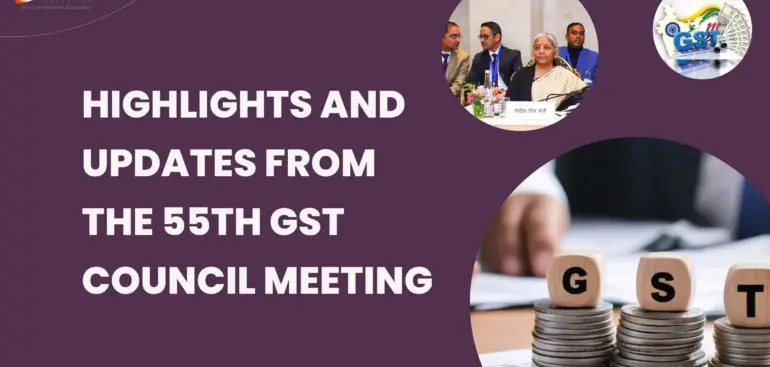
Highlights and Updates from the 55th GST Council Meeting

Highlights and Updates from the 55th GST Council Meeting

The 55th GST Council meeting, held on December 21, 2024, in Jaisalmer, Rajasthan, was chaired by the Union Finance Minister. Attendees included the Union Minister of State for Finance, several Chief and Deputy Chief Ministers, State Finance Ministers, and senior officers from the Ministry of Finance and State/UT governments.

Key Decisions from the 55th GST Council Meeting

Extensions and Exemptions:

  • Group of Ministers (GoM) Extensions: The GoMs on compensation cess, rate rationalization, and health insurance have been granted extensions to submit their reports.

  • GST Exemption for Payment Aggregators: Payment aggregators handling payments below ₹2,000 are now exempt from GST. This exemption does not extend to payment gateways or fintech services that facilitate fund settlements.

  • Penal Charges: Penal charges levied by banks and NBFCs on borrowers for non-compliance with loan terms will no longer attract GST.

  • Agricultural Products: Dried black pepper and raisins supplied directly by agriculturists are now exempt from GST.

GST Rate Adjustments:

  • Fortified Rice Kernels (HSN 1904): GST reduced from 18% to 5%.

  • Gene Therapy: Treatments for life-threatening diseases are now GST-exempt.

  • Caramelized Popcorn: Clarified to attract GST at 18%, aligning with products containing added sugar. Salted popcorn remains taxed at 5%.

  • Electric Vehicles (EVs):

    • No GST on the sale of used EVs between individuals.

    • 18% GST on the margin value for businesses selling refurbished EVs.

  • Merchant Exporters: Compensation cess on supplies to merchant exporters reduced to 0.1%.

  • LRSAM Sub-Systems and Software (HSN 9023): Exempted from GST.

  • Inspection Equipment for IAEA: Imports by the International Atomic Energy Agency are now exempt from IGST, subject to specified conditions.

Deferred Decisions:

  • Food Delivery Services: Deliberations on GST rates for food and associated delivery charges by quick commerce and food delivery apps were postponed.

  • Health and Life Insurance: Discussions on reducing GST rates for health and life insurance premiums are ongoing.

Legislative Amendments and Compliance Measures:

  • Invoice Management System (IMS): Proposed amendments to the CGST Act and Rules aim to streamline the generation of FORM GSTR-2B and ensure reconciliation between suppliers and recipients.

  • Credit Note Adjustments: New provisions for credit note-related input tax credit (ITC) reversals and output tax liability adjustments.

  • Late Fee Waivers:

    • Waiver of late fees for delayed filing of FORM GSTR-9C for FY 2017-18 to FY 2022-23, provided filings are completed by March 31, 2025.

    • Circular to clarify late fee applicability for delayed filing of annual returns.

  • Pre-Deposit for Appeals: Pre-deposit reduced to 10% for appeals involving only penalties, without any tax demand.

Expectations and Anticipated Changes:

  • Health Insurance Premiums:

    • Proposals include exempting GST on term life insurance and senior citizens’ health insurance premiums.

    • Reducing GST rates from 18% to 5% for health insurance premiums under specified conditions.

  • Inverted Duty Structure Reforms: Addressing tax rate disparities between raw materials and finished goods to ease ITC accumulation and improve liquidity.

  • Tobacco Products and High-End Goods: Possible introduction of special rates (including cess) for items like tobacco, cosmetics, luxury garments, and aerated beverages.

  • ATF and Petroleum Products: Ongoing discussions on including aviation turbine fuel (ATF) under GST to enable input tax credit claims by petroleum companies.

  • Compensation Cess: Examining the applicability and future roadmap of the cess, especially for utility vehicles and specific luxury goods.


Read More: A Guide to Belated Returns, Revised Returns, and ITR-U

Compliance Enhancements:

  • Risk-Based GST Registration: Strengthened measures, including Aadhaar-based authentication and categorization of taxpayers based on risk profiles, to curb fraudulent registrations.

The 55th GST Council meeting underscored its commitment to refining GST policies, addressing industry concerns, and promoting clarity and compliance. Future notifications and circulars will implement these decisions, further shaping the GST framework in India.

Related Post

image

Section 54F: Save LTCG Tax by Investing in a House

Section 54F: Save LTCG Tax by Investing in a House Section 54F of the Income Tax Act is a powerful tax-saving provision that helps taxpayers reduce Long-Term Capital Gains (LTCG)…
image

Income Tax Act, 2025: A New, Modern, and Simplified Tax Framework for India

Income Tax Act, 2025: A New, Modern, and Simplified Tax Framework for India The Income Tax Act, 2025 represents one of the most important tax reforms in India’s legislative history.…
image

Income Tax Refund Delays: CBDT Targets December Deadline — Here’s Why Refunds Are Held Up & How to Check Your Status

Income Tax Refund Delays: CBDT Targets December Deadline — Here’s Why Refunds Are Held Up & How to Check Your Status Millions of taxpayers across India have been anxiously waiting…

Book A One To One Consultation Now
For FREE

How can we help? *

A Guide to Belated Returns, Revised Returns, and ITR-U

ITR

A Guide to Belated Returns, Revised Returns, and ITR-U

ITR

Filing Income Tax Returns (ITR) is a crucial responsibility for taxpayers in India. As the year nears its end, December 31, 2024, is the final date to submit belated and revised returns for the financial year 2023-24 (assessment year 2024-25). This guide explains the distinctions between these filing options, their implications, and how missing deadlines can lead to penalties.

Filing Belated Income Tax Returns

A belated return is filed after the original deadline, which was July 31, 2024, for the financial year 2023-24. Taxpayers who missed this deadline can still file their belated return by December 31, 2024.

Consequences of Late Filing

As per Section 139(4) of the Income Tax Act, filing a belated return incurs penalties:

  • Penalty Amount: Rs 5,000, reduced to Rs 1,000 if taxable income is below Rs 5 lakh.
  • Exemption: No penalty applies if income falls below the basic exemption limit of Rs 3 lakh.

However, there are certain limitations:

  • New Tax Regime Default: Taxpayers filing belated returns are restricted to the new tax regime, which offers limited deductions like:
    • Standard deduction of Rs 50,000.
    • Employer’s NPS contribution up to 10% of basic salary.
    • No deductions under popular sections like 80C, 80D, or for HRA exemptions.
  • Limited Tax Savings: The extensive deductions and exemptions available in the old tax regime cannot be claimed.
ITR

Submitting Revised Income Tax Returns

A revised return allows taxpayers to correct mistakes or omissions in their originally filed ITR. As per Section 139(5), taxpayers can revise their returns multiple times within the allowable timeframe.

Key Details About Revised Returns

  • Deadline: The revised return for FY 2023-24 can be filed until December 31, 2024, or before the assessment completion, whichever comes earlier.
  • Restrictions: Revised returns cannot:
    • Decrease the tax liability reported in the original or belated return.
    • Increase the refund amount.
    • Report previously unclaimed losses.
  • Avoid Frequent Changes: Repeated revisions may attract scrutiny from tax authorities.

Taxpayers can revise their return even after receiving an intimation under Section 143(1). However, revisions are not allowed once the return undergoes scrutiny under Section 143(3).

Using ITR-U: The Updated Income Tax Return

Introduced in Budget 2022, the ITR-U form enables taxpayers to correct missed filings or disclosures for up to two years from the end of the relevant assessment year.

When to File ITR-U

Starting January 1 of the assessment year, taxpayers can use ITR-U to make corrections, subject to certain limitations:

    • No Tax Reduction: It cannot be used to lower tax payable.
    • No Refunds: Refund claims cannot be made through ITR-U.
    • No Loss Adjustments: Adjustments or increases in losses are not allowed.

Final Thoughts

December 31, 2024, is a critical deadline for filing belated and revised returns for FY 2023-24. Missing this date leaves ITR-U as the only option, though it has its own restrictions. Taxpayers should ensure timely and accurate filings to avoid penalties and maximize tax benefits. Understanding these options aids in compliance and helps prevent potential complications.

Related Post

image

Section 54F: Save LTCG Tax by Investing in a House

Section 54F: Save LTCG Tax by Investing in a House Section 54F of the Income Tax Act is a powerful tax-saving provision that helps taxpayers reduce Long-Term Capital Gains (LTCG)…
image

Income Tax Act, 2025: A New, Modern, and Simplified Tax Framework for India

Income Tax Act, 2025: A New, Modern, and Simplified Tax Framework for India The Income Tax Act, 2025 represents one of the most important tax reforms in India’s legislative history.…
image

Income Tax Refund Delays: CBDT Targets December Deadline — Here’s Why Refunds Are Held Up & How to Check Your Status

Income Tax Refund Delays: CBDT Targets December Deadline — Here’s Why Refunds Are Held Up & How to Check Your Status Millions of taxpayers across India have been anxiously waiting…

Book A One To One Consultation Now
For FREE

How can we help? *