


LINK YOUR PAN TO AADHAAR OR FACE CONSEQUENCES – HERE’S WHAT YOU NEED TO KNOW

LINK YOUR PAN TO AADHAAR OR FACE CONSEQUENCES – HERE’S WHAT YOU NEED TO KNOW

Did you receive a message from the tax authorities stating that your PAN will soon become inoperative? If so, here are some crucial points you should know.

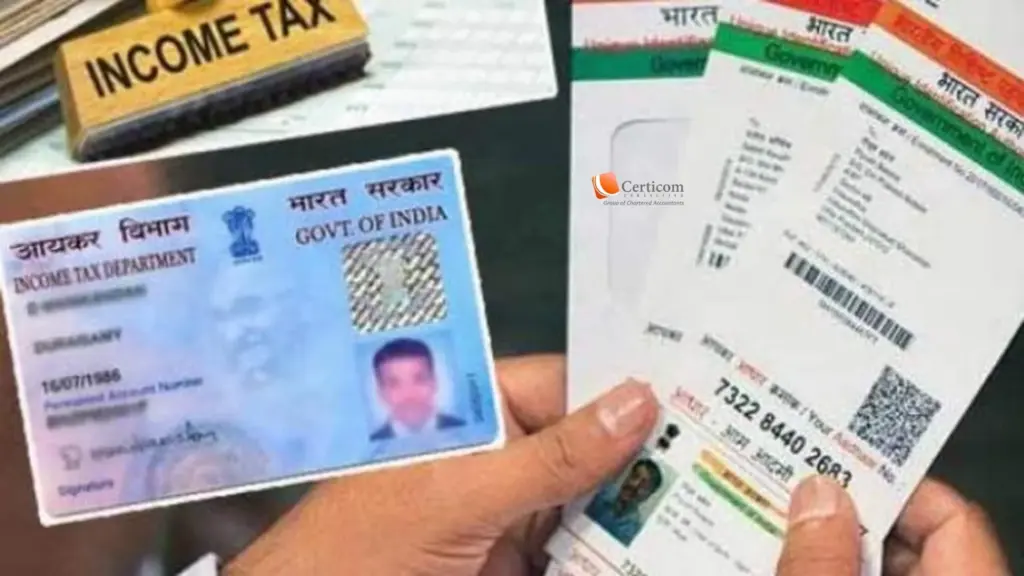
The Aadhaar card contains a unique 12-digit number issued to every Indian citizen by the Unique Identification Authority of India (UIDAI). This number provides access to the cardholder’s details in the government database, such as biometrics and contact information.

The Permanent Account Number or PAN is a means of identifying taxpayers in India. It contains a unique 10- digit alphanumeric identification number assigned to Indians, particularly those who pay tax.

It is compulsory to link Aadhaar with PAN, as it aids in income tax proceedings.

How to Check If Your Aadhaar and PAN are Linked:

1. Firstly, visit the official income tax website: https://www.incometax.gov.in/iec/foportal/

2. On the home page, click on the “Link Aadhaar status.”

3. Enter your Aadhaar number and PAN number.

4. Click on “View Aadhaar link status.”

A warning message will appear on the screen if your PAN and Aadhaar are not linked.

Who is Exempted from Aadhaar and PAN Linkage?


  • Residents of Assam, Jammu and Kashmir, and Meghalaya.
  • Non-residents as per the Income-tax Act, 1961.
  • Those aged eighty years or more at any time during the previous year.
  • Non-citizens of India.

The Income Tax authorities also stated that anyone who falls into one of the above categories can voluntarily link their Aadhaar with PAN without facing any consequences.

How to Link PAN and Aadhaar:

This can be achieved in two ways:

  • Submit online or offline link requests for PAN and Aadhaar.
  • Pay fees on the NSDL portal under Major head (0021) and Minor head (500) for AY 2023-24.

Why is it Crucial to Link PAN with Aadhaar?

PAN and Aadhaar are unique identification cards that serve as proof of identity for various registration and verification purposes. Linking of PAN and Aadhaar is necessary for the following reasons:


i. To prevent tax evasion:

The government can monitor all taxable transactions of a taxpayer by linking Aadhaar and PAN, thereby eliminating tax evasion.


ii. To combat multiple PAN cards:

Linking PAN and Aadhaar reduces the chances of individuals orentities applying for multiple PAN cards to defraud the government and evade taxes.


iii. Restrictions on financial activities:

Without linking, you cannot open a bank account/demat account, make large deposits, purchase mutual funds above a certain limit, buy or sell items or services beyond a certain value, and your pending returns and refunds will not be processed.

iv. Increased TDS/TCS: TDS/TCS might sometimes apply at rates of 30%.


v. Credit/debit card restrictions: You will not be able to get new credit or debit cards.


Finally, if you have not linked your PAN with Aadhaar, your PAN becomes inoperative from 1st July 2023.


Penalty for Non-linking of PAN with Aadhaar:

If PAN and Aadhaar are not linked by 30th June 2023, the PAN becomes inoperative from 1st July 2023. You can still link PAN and Aadhaar by paying a penalty of 1,000 INR to the department.

Moreover, the reactivation process takes around 30 days from the date of linking to reactivate the PAN card. For instance, if you initiate the process of PAN card activation today, i.e., on July 6th, your PAN card will become operative by August6th.

Read More: IMPORTANT DEADLINES IN JULY 2023: ITR FILING, EPFO PENSION, TDS

Requirements for Linking PAN and Aadhaar:

i. PAN Card
ii. Aadhaar card
iii. Mobile number

So, if you’ve already linked your accounts, verify your status. For those who haven’t, it’s time to hurry and link your PAN with Aadhaar.

Related Post

image

Virtual Digital Assets in India: A Taxation Guide

Virtual Digital Assets in India: A Taxation Guide The emergence of Virtual Digital Assets (VDAs), such as cryptocurrencies and Non-Fungible Tokens (NFTs), has redefined the global financial ecosystem. In India,…

image

Five Key Income Tax Changes for Salaried Employees: August 2025

Five Key Income Tax Changes for Salaried Employees: August 2025 Introduction: What Changed in August 2025? August 2025 marked a turning point for salaried employees in India’s taxation landscape. With…

image

GST and Digital Commerce: Understanding the Indian Regulatory Landscape

GST and Digital Commerce: Understanding the Indian Regulatory Landscape E-commerce has revolutionized India’s marketplace, changing the way goods and services are purchased. Platforms like Amazon, Flipkart, Zomato, and Swiggy have…


Book A One To One Consultation Now
For FREE

How can we help? *

A COMPREHENSIVE GUIDE TO SAVING CAPITAL GAINS TAX IN INDIA

A COMPREHENSIVE GUIDE TO SAVING CAPITAL GAINS TAX IN INDIA

Capital gains tax is an essential aspect of taxation in India, applicable when you sell certain assets and make a profit. However, there are several legitimate strategies you can employ to save on capital gains tax. In this blog, we’ll explore various scenarios and provide practical examples to help you understand how to minimize your tax liability.

Long-term Capital Gains (LTCG)

Scenario: Selling Stocks after Holding for More Than One Year

Example: Rahul purchased 500 shares of XYZ Ltd. in January 2019 at Rs. 100 per share. In February 2021, he sold these shares at Rs. 200 per share, resulting in a gain of Rs. 50,000.

a. Utilizing Section 54EC: Rahul can invest the capital gains (up to Rs. 50 lakhs) in specified bonds issued by NHAI or REC within six months to save tax on LTCG. This exemption is available only once in three years.

b. Opting for Section 54F: If Rahul invests the entire sale proceeds (not just capital gains) in a residential property within two years or constructs a property within three years, he can claim exemption under Section 54F.

2. Short-term Capital Gains (STCG):

Scenario: Selling Property within Three Years of Purchase

Example: Meera bought a residential property in April 2020 for Rs. 50 lakhs. In September 2021, she sold it for Rs. 65 lakhs, resulting in a gain of Rs. 15 lakhs.

a. Offsetting with STCG Losses: If Meera has incurred short-term capital losses (STCL) in other assets during the financial year, she can offset these against her STCG. This will reduce her taxable income and the resultant tax liability.

b. Reinvesting in a Residential Property: Meera can reinvest the entire capital gains within two years or construct a residential property within three years to avail of the exemption under Section 54.

3. Capital Gains from Mutual Funds:

Scenario: Redeeming Mutual Fund Investments

Example: Aman invested in an equity mutual fund scheme in January 2018. In May 2021, he decided to redeem his investment, resulting in a long-term capital gain of Rs. 2 lakhs.

a. Opting for Section 54EC Bonds: Aman can invest the capital gains (up to Rs. 50 lakhs) within six months in specified bonds to save on LTCG tax.

b. Utilizing Section 54F: Alternatively, Aman can invest the entire sale proceeds (not just capital gains) in a residential property within two years or construct a property within three years to claim exemption under Section 54F.

4. Capital Gains from Selling Gold:

Scenario: Selling Gold Jewellery or Bullion

Example: Sneha inherited gold jewellery worth Rs. 10 lakhs from her grandmother. In October 2021, she sold it and realized a long-term capital gain of Rs. 2 lakhs.

a. Opting for Section 54F: Sneha can invest the entire sale proceeds in a residential property within two years or construct a property within three years to claim exemption under Section 54F.

b. Utilizing Section 54EC Bonds: Another option for Sneha is to invest the capital gains (up to Rs. 50 lakhs) in specified bonds within six months to save tax on LTCG.

Read More: Why MNC employees with Esops are on taxman’s radar

Saving on capital gains tax in India requires careful planning and understanding of the relevant tax provisions. By exploring various scenarios and examples, we have outlined strategies such as utilizing exemptions under Sections 54, 54EC, and 54F, offsetting losses, and reinvesting in specified assets. However, it is crucial to consult a qualified tax professional or financial advisor to ensure compliance and make informed decisions based on your specific circumstances. With the right knowledge and appropriate strategies, you can effectively minimize your capital gains tax and maximize your after-tax returns.

Related Post

image

Virtual Digital Assets in India: A Taxation Guide

Virtual Digital Assets in India: A Taxation Guide The emergence of Virtual Digital Assets (VDAs), such as cryptocurrencies and Non-Fungible Tokens (NFTs), has redefined the global financial ecosystem. In India,…
image

Five Key Income Tax Changes for Salaried Employees: August 2025

Five Key Income Tax Changes for Salaried Employees: August 2025 Introduction: What Changed in August 2025? August 2025 marked a turning point for salaried employees in India’s taxation landscape. With…
image

GST and Digital Commerce: Understanding the Indian Regulatory Landscape

GST and Digital Commerce: Understanding the Indian Regulatory Landscape E-commerce has revolutionized India’s marketplace, changing the way goods and services are purchased. Platforms like Amazon, Flipkart, Zomato, and Swiggy have…

Book A One To One Consultation Now
For FREE

How can we help? *

DELAY IN TAX AUDIT DUE TO ONGOING ASSESSMENT IN SOME OTHER ACT. PENALTY U/S 271B TO BE DELETED

Penalty u/s 271B must be removed if a tax audit is delayed due to an ongoing assessment under another Act.

The assessee filed a return of income on January 6, 2016, which was inspected under Section 143. (3). Because the assessee’s total turnover/gross receipts surpassed the Rs.1 crore threshold, he was required to have his accounts audited under Section 44AB of the Act and submit the audit report before the deadline, which in this case was October 31, 2015. Because the accounts were not audited within the time limit, Ld. AO imposed a penalty of Rs.1,12,715/- under section 271B.

The sentence was upheld by CIT(A) on appeal. Assessee preferred an appeal to the tribunal after being aggrieved by the order.

The ld. AR argued before the tribunal that there was adequate cause for the audit to be delayed because the assessee was a cooperative society governed by the Tamil Nadu Cooperative Societies Act, 1983 and its rules. The society’s finances could not be audited for the relevant AY until the assessment was completed. Because the assessee society was not in charge of the matters connected to the appointment and completion of the audit under the aforementioned Act and Rules, the delay in the completion of the audit was not due to any fault on their part. As a result, this qualifies as fair cause, and the penalty was eliminated.

Related Article…

[pt_view id=”baa39696xe”]

On the other hand, the Ld. DR justified the sentence by claiming that it was imposed in conformity with the law. After hearing both parties, the ITAT determined that there was adequate cause for the late filing of the income tax return and audit. The assessee was audited under the Tamil Nadu Cooperative Societies Act, 1983, and its implementing rules.

The assessee had no control over the appointment of an auditor or the execution of the audit. It should also be highlighted that the audit was eventually finished on December 31, 2015, and the assessee promptly filed a return. As a result, ITAT removed the penalty.