
How to know your Universal Account Number?

 How to know your UAN?

a. Through Employer

In the normal case, you can easily get your UAN from your employer allotted to you. Some employers print the UAN number in the pay slips.

b. Through UAN Portal using PF number/member ID

It is possible, that you are unable to get your Universal Account Number from the employer, you can obtain the UAN number through UAN portal also. Follow the below steps:

Step 1: Go the UAN Portal https://unifiedportal-mem.epfindia.gov.in/memberinterface/

Step 2: Click on the tab ‘Know your UAN Status’. The following page will be displayed.

UAN

Step 3: Select your state and EPFO office from the drop-down menu and enter your PF number/member ID awith the other details. You can get the PF number/member ID from your salary slip. Enter the tab ‘Get Authorization Pin’.

Step 4: You will get an OTP on your mobile number.

Step 5: Your Universal Account Number will be sent to your mobile number.

3. How to activate and log in to the EPFO website using UAN?

In order to activate UAN, it is essential that you have your Universal Account Number and PF member id with you. Given below are steps to activate.

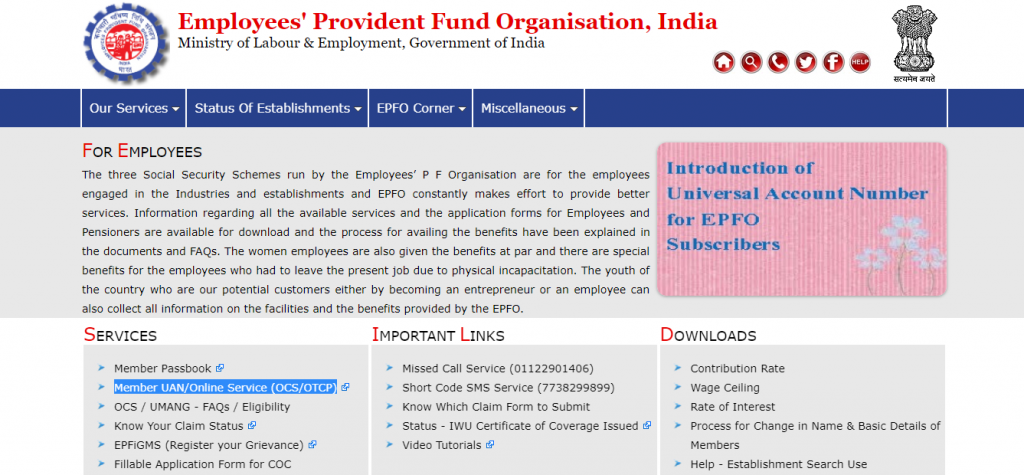
Step 1: Go the EPFO homepage and click on ‘For Employees’ under ‘Our Services’ on the dashboard.

1

Step 2: Click on ‘Member UAN/Online services’ in the services section. You would reach the UAN portal.
2

Step 3: Do you have any questions about tax or finance you need help with?

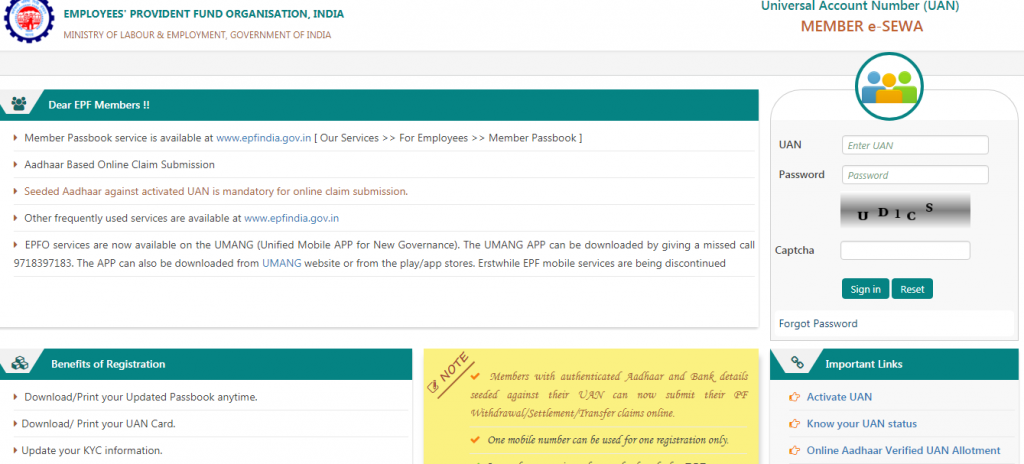
  • Enter your UAN, mobile number and PF member ID. Enter the captcha characters. Click on ‘Get authorization PIN’ button. You will receive the OTP on your registered mobile number.
  • Click on ‘I Agree’ under the Disclaimer checkbox and enter the OTP that you receive on your mobile number and click on ‘Validate OTP and Activate UAN’.
  • On activation of the UAN, you will receive a password on your registered mobile number to access your account.
UAN

4. Advantages of UAN to employees

  • Every new PF account with a new job will come under the umbrella of a single unified account.
  • It is easier to withdraw (fully or partially) PF online with this number.
  • Now the employees themselves can transfer PF balance from old to new using this unique account number.
  • Any time you want a PF statement (visa purpose, loan security etc.), you can download one instantly – either by logging in using member ID or UAN or by sending an SMS.
  • There will be no need for new employers to validate your profile if the UAN is already Aadhaar and KYC-verified.
  • UAN ensures that employers cannot access or withhold the PF money of their employees.
  • It is easier for employees to ensure that his/her employer is regularly depositing their contribution in the PF account.

5.  Benefits & Features of UAN

  • Universal Account Number or UAN helps to centralize employee data in the country.
  • One of the biggest use of this unique number is that it brings down the burden of employee verification from companies and employers by EPF organization.
  • This account made it possible for EPFO to extract the bank account details and KYC of the member and KYC without the help of employers.
  • It is useful for EPFO to track multiple job switches of employee.
  • Untimely and early EPF withdrawals have reduced considerably with the introduction of UAN.

6. Documents required to open UAN

If you have just entered your first job or first job in a registered company, you require the following documents to get your Unique Account Number.

  • Bank account info-account number, IFSC code, branch name.
  • ID Proof – Any photo-affixed and national identity card like Driving License, Passport, Voter ID, Aadhaar, SSLC Book
  • Address Proof: A recent utility bill in your name, rental/lease agreement, ration card or any of the ID proof mentioned above if it has your current address
  • PAN card – Your PAN Number should be linked to UAN
  • Aadhaar Card –  SInce Aadhaar is linked to the bank account and mobile number, it is mandatory.
  • ESIC card

[frontpage_news widget=”879″ name=”Certicom – A Group of Chartered Accountants – Articles”]

Liquidity crisis

Centre, RBI see eye to eye in ‘public interest’

After a high-pitched spat over last week, the Reserve Bank of India (RBI) and the government on Wednesday seemed to agree to continue discussions to resolve their recent disagreements — in “public interest”. Speculation was rife on RBI Governor Urjit Patel’s imminent resignation on Wednesday morning. But by afternoon, he had called a board meeting on November 19 to continue discussions. The finance ministry also issued a statement:

The central bank and the government have to be guided by public interest and the requirements of the Indian economy.


“The autonomy for the central bank, within the framework of the RBI Act, is an essential and accepted governance requirement. Governments in India have nurtured and respected this.  The government and the central bank had disagreed on several issues such as dividend transfer, capital adequacy norms, and liquidity needs of non-banking financial companies (NBFCs). The RBI for now is focused on providing adequate liquidity to the system.

In October, it announced Rs 360 billion of open market operations (OMO) to buy bonds from the secondary market. In November, it plans to buy Rs 400 billion worth of secondary market bonds. The first of such purchases, totalling Rs 120 billion, will happen on Thursday.

The market has taken comfort from the RBI’s focus on providing liquidity. The 10-year bond yield closed at 7.85 per cent, marginally up from its previous close of 7.83 per cent. The rupee closed at 73.95 a dollar, up from its day’s low of 74.15 a dollar on reports of invocation of Section 7 of the RBI Act.

In the first fortnight of October, the department of economic affairs sent three letters to the RBI Governor referring to Section 7 to hold discussions on various regulatory policies. The government gave suggestions and sought the views of Patel on a host of issues, including dividend transfer, stressed power assets, easing prompt corrective action norms (PCA), forbearances for micro, small and medium enterprises, foreign portfolio investors, and NBFC liquidity, among others.

The RBI replied to the government’s letter within a given timeframe as required in the statute, sources said. Though the government’s letters mentioned Section 7, it did not invoke Section 7(1) that says the Centre may issue directions to the RBI after holding consultation with its governor “in public interest.

Will the government say whether such letters have been written and whether the letters specifically refer to Section 7 of the RBI Act?

The finance ministry said in its statement that it places its “assessment” on issues and suggests possible solutions and will continue to do so.

“Extensive consultations on several issues take place between the government and the RBI from time to time. This is equally true of all other regulators. The Government of India has never made public the subject matter of those consultations. Only the final decisions taken are communicated. The issue of the government threatening to invoke Section 7 of RBI Act cannot be separated from the current tensions between the North Block and the central bank, which culminated in a full-blown argument between the Economic Affairs Secretary Subhash Garg and Governor Urjit Patel in the last meeting of the RBI’s board of directors.

Subject to these directions, this section also talks of superintendence and direction by the central board in the affairs of the RBI. Both the nominees of the government in the central board do not have voting power in the board. The previous board meeting, held last week, went on for about nine hours and was adjourned as no decision was taken on a number of issues flagged by the government’s nominees Garg and Financial Services Secretary Rajiv Kumar.

[frontpage_news widget=”879″ name=”Certicom – A Group of Chartered Accountants – Articles”]

Foreign ecommerce companies

Foreign e-commerce companies rush to register for GST in all states

Amazon, Google, Apple and other foreign companies that operate in the electronic commerce space will have to register for the tax on goods and services (GST) in all states in the next 10 to 12 days.

The government has said that e-commerce companies must collect the tax at the source as of October 1. To comply with taxes levied at the source (TCS), e-commerce players must register in each state. This provision applies to both foreign players and Indian consumers.

A clarification to this effect was given at a meeting between e-commerce players and the Central Board of Indirect Taxes and Customs held on Tuesday, according to a person deprived of the deliberations of the meeting.

However, the provision mentions the rate as up to 1%, the rate, for now, will be 0.5% for each state and central GST.

For e-commerce companies, this implies a deduction of 1% of payments to their suppliers for goods sold on their platforms that must be deposited with the government. Tax experts said the government should provide a centralized registry for foreign e-commerce players.

There is no exemption from registration for foreign e-commerce companies

[frontpage_news widget=”879″ name=”Certicom – A Group of Chartered Accountants – Articles”]