2 years of Demonetisation

5 trends that defined India’s digital payments industry 

Two years ago, Prime Minister Narendra Modi put the entire nation in a frenzy. In one stroke, the government made Rs 500 and Rs 1,000 denomination notes invalid, leaving the country of 1.3 billion in a limbo.

As citizens queued up outside banks to deposit old currency notes in exchange for new ones, the digital payments ecosystem saw a huge opportunity to open up. Right after the prime minister announced the ban on high-value currency notes.

And they did!

Two years later,

All payment and settlement systems – NEFT, IMPS, UPI, NACH, card payments, Electronic Clearing Systems as well as Forex and market clearing systems – have seen a 44.6 per cent increase in volume in 2017-18 and an 11.9 percent increase in the value of funds transferred.

In the annual report, RBI also said that during the financial year 2016-17, the volume of transactions through digital payment systems witnessed a 56 per cent increase, with the value of funds increasing by 24.8 per cent.

Transactions across the digital retail payment infrastructure, which includes card payments, UPI and others increased to 92.6 per cent in 2017-18, up from 88.9 per cent in the previous year. [Report here]

The RBI also said the share of paper-based clearing instruments reduced from 11.1 per cent in 2016-17 to 7.4 per cent in 2017-18, showing a strong trend in favour of digital payments.

The growth of debit cards stalled after Demonetisation 

From FY16 to FY17, the total number of credit and debit cards grew by almost 29 per cent, but this trend didn’t quite sustain in the next financial year. Card growth fell sharply in FY18, growing at 1.5 per cent, with total physical cards in the country standing at almost 900 million.

This can be attributed to the slow growth of debit cards post demonetisation, which showed less than 1 per cent growth between FY17 and FY18. Credit cards maintained an average 20 per cent increase year-on-year.

Debit card growth in the country is now back on track, having grown 13.6 per cent as of August this financial year. As of August 2018, there were a total of 1.02 billion credit and debit cards in the country.

Acceptance of digital infrastructure   

Acceptance of digital infrastructure has grown since demonetisation with the number of Point of Sale (POS) terminals increasing by 24 per cent from 2.53 million in 2016-17 to 3.08 million in 2017-18, according to the RBI. During the same period, the number of ATMs deployed by banks witnessed a marginal decline from 222,475 to 222,247.

The digital infrastructure still needs to expand as currently, for a total 1.02 billion credit and debit cards in the country, there are only 3.3 million PoS devices and only 228,422 ATMs.

That means for every 309 million cards in the country there is one PoS machine available as an acceptance point.

UPI – the real winner

When it comes to digital payments, Unified Payments Interface has been the real winner.

Despite Prime Minister Narendra Modi pushing digital payments app BHIM which runs on the UPI infrastructure, the total volume of UPI payments stood at 17.9 million in FY17. And the value of funds transferred for the same period, stood at Rs 6,900 crore, according to the RBI.

In 2017-18, after the adoption of UPI by private players like Google, Paytm and others, the total number of transactions skyrocketed by more than 5,000 per cent. In FY18, the total number of UPI transactions stood at 915.2 million and total funds transferred on the service stood at Rs 1.09 lakh crore.

Within eight months of this year, according to data from National Payments Corporation of India (NPCI), UPI transactions in the country have already crossed the 2 billion mark with a total Rs 3.42 lakh crore being transferred.

Content credit: Your Story

Who gets more amounts of tax?

Who gets more amounts of tax, the central or the state government?

The central government gets more tax than the state government. The tax collection of the central government is vast. It gets taxes from all states but the state gets tax only from its territory.

Central or State Government

For example, we are paying GST 18% where the state government gets 9% and the central government gets 9%. Multiply it into all states, you will get the desired result.

[frontpage_news widget=”879″ name=”Certicom – A Group of Chartered Accountants – Articles”]

How to know your Universal Account Number?

 How to know your UAN?

a. Through Employer

In the normal case, you can easily get your UAN from your employer allotted to you. Some employers print the UAN number in the pay slips.

b. Through UAN Portal using PF number/member ID

It is possible, that you are unable to get your Universal Account Number from the employer, you can obtain the UAN number through UAN portal also. Follow the below steps:

Step 1: Go the UAN Portal https://unifiedportal-mem.epfindia.gov.in/memberinterface/

Step 2: Click on the tab ‘Know your UAN Status’. The following page will be displayed.

UAN

Step 3: Select your state and EPFO office from the drop-down menu and enter your PF number/member ID awith the other details. You can get the PF number/member ID from your salary slip. Enter the tab ‘Get Authorization Pin’.

Step 4: You will get an OTP on your mobile number.

Step 5: Your Universal Account Number will be sent to your mobile number.

3. How to activate and log in to the EPFO website using UAN?

In order to activate UAN, it is essential that you have your Universal Account Number and PF member id with you. Given below are steps to activate.

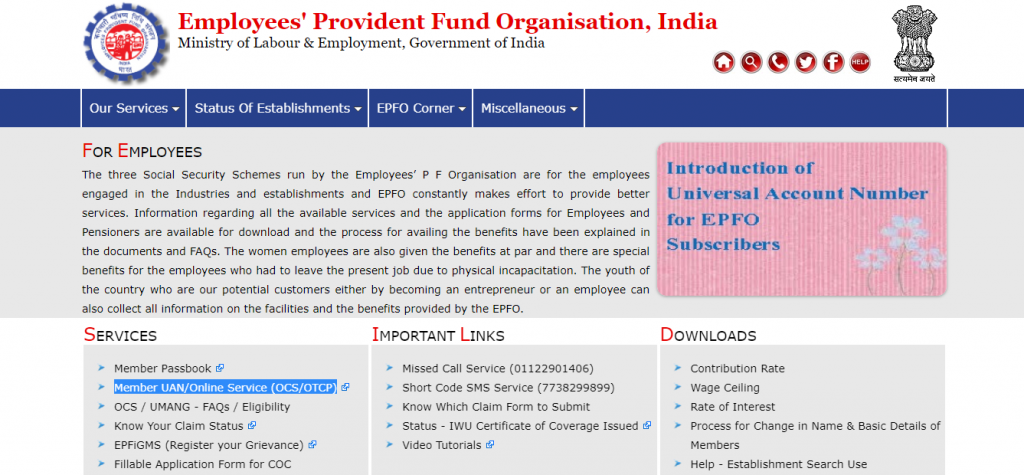
Step 1: Go the EPFO homepage and click on ‘For Employees’ under ‘Our Services’ on the dashboard.

1

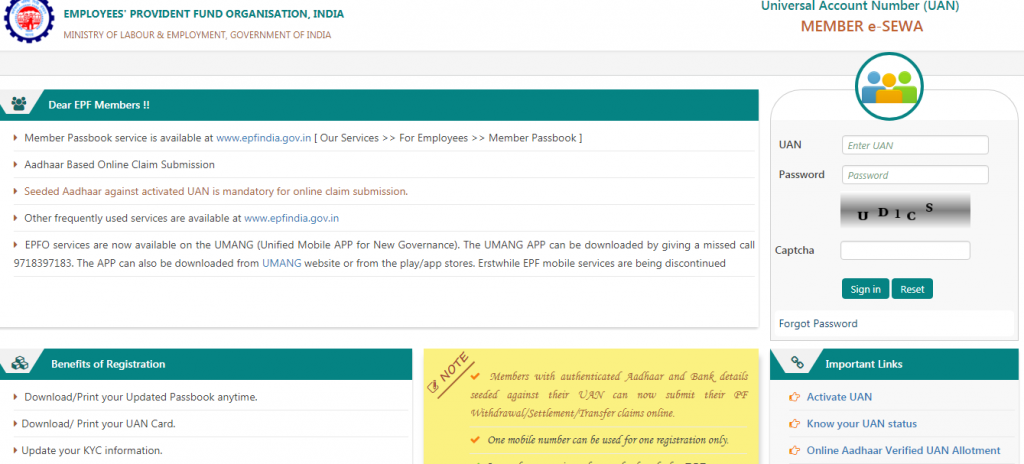
Step 2: Click on ‘Member UAN/Online services’ in the services section. You would reach the UAN portal.

2

Step 3: Do you have any questions about tax or finance you need help with?

  • Enter your UAN, mobile number and PF member ID. Enter the captcha characters. Click on ‘Get authorization PIN’ button. You will receive the OTP on your registered mobile number.
  • Click on ‘I Agree’ under the Disclaimer checkbox and enter the OTP that you receive on your mobile number and click on ‘Validate OTP and Activate UAN’.
  • On activation of the UAN, you will receive a password on your registered mobile number to access your account.

UAN

4. Advantages of UAN to employees

  • Every new PF account with a new job will come under the umbrella of a single unified account.
  • It is easier to withdraw (fully or partially) PF online with this number.
  • Now the employees themselves can transfer PF balance from old to new using this unique account number.
  • Any time you want a PF statement (visa purpose, loan security etc.), you can download one instantly – either by logging in using member ID or UAN or by sending an SMS.
  • There will be no need for new employers to validate your profile if the UAN is already Aadhaar and KYC-verified.
  • UAN ensures that employers cannot access or withhold the PF money of their employees.
  • It is easier for employees to ensure that his/her employer is regularly depositing their contribution in the PF account.

5.  Benefits & Features of UAN

  • Universal Account Number or UAN helps to centralize employee data in the country.
  • One of the biggest use of this unique number is that it brings down the burden of employee verification from companies and employers by EPF organization.
  • This account made it possible for EPFO to extract the bank account details and KYC of the member and KYC without the help of employers.
  • It is useful for EPFO to track multiple job switches of employee.
  • Untimely and early EPF withdrawals have reduced considerably with the introduction of UAN.

6. Documents required to open UAN

If you have just entered your first job or first job in a registered company, you require the following documents to get your Unique Account Number.

  • Bank account info-account number, IFSC code, branch name.
  • ID Proof – Any photo-affixed and national identity card like Driving License, Passport, Voter ID, Aadhaar, SSLC Book
  • Address Proof: A recent utility bill in your name, rental/lease agreement, ration card or any of the ID proof mentioned above if it has your current address
  • PAN card – Your PAN Number should be linked to UAN
  • Aadhaar Card –  SInce Aadhaar is linked to the bank account and mobile number, it is mandatory.
  • ESIC card

[frontpage_news widget=”879″ name=”Certicom – A Group of Chartered Accountants – Articles”]